quinta-feira, 20 de agosto de 2026

My Daughter - Aletheia, by Alexander Dugin. 20/8/2026, anniversary of the tragic death of Daria or Dasha Dugina.

                           My Daughter  - Aletheia [Truth].

Here we have a very poetic, beautiful, and spiritual hermeneutics generated and given by Alexander Dugin about the soul and ideas, the death and mission of his martyr daughter Daria Dugina Platonova, a living philosophical symbol of Truth, Aletheia, and also how to commune with her and intensify her Eschatological Optimism, in these times of the end [of illusions about this] world, and of a more intense unveiling of the face or vision of Truth, Justice, and Love, specially for those who fight internally and externally for a multipolar and better world and Mankind.

 «Our friends — Dasha’s Italian friends, friends of Russia, friends of my family — have decided to honor the memory of Daria Dugina on this 20th of August, 2026, the anniversary of her tragic death, with an intellectual festival — a philosophical, musical, creative festival.

I am touched that Dasha’s memory is not fading. Her texts are being published, her ideas continue to be discussed, her figure is not withering.

Plato said that ideas either soar or they die. Dasha’s ideas are soaring. They are inspiring others to great feats. I don’t think that we’re talking about the masses, although in Russia pretty much everyone now knows about Dasha. Streets have been named after her; monuments to her have been raised; songs and poems, illustrations and festivals, museums and expositions are dedicated to her.

Nevertheless, Dasha remains an unusual symbol. She inspires, above all, those differentiated people who, although they dwell within the modern world, do not belong to it and are separate from it by virtue of the difference in their inner nature.

Dasha herself was differentiated. And she expressed this consciousness in one of her main ideas: eschatological optimism — being active in the world, and even partially open to it, with the clear awareness that this world’s end is nearer than ever before.

Furthermore, Dasha is a philosophical symbol. It is no coincidence that the sculptor Dmitry Alexandrov, a friend of Dasha’s, created a monument to her which depicts her with a book. The book has no title on it, but I think that it is Plato. [Or her books, and the Book...]
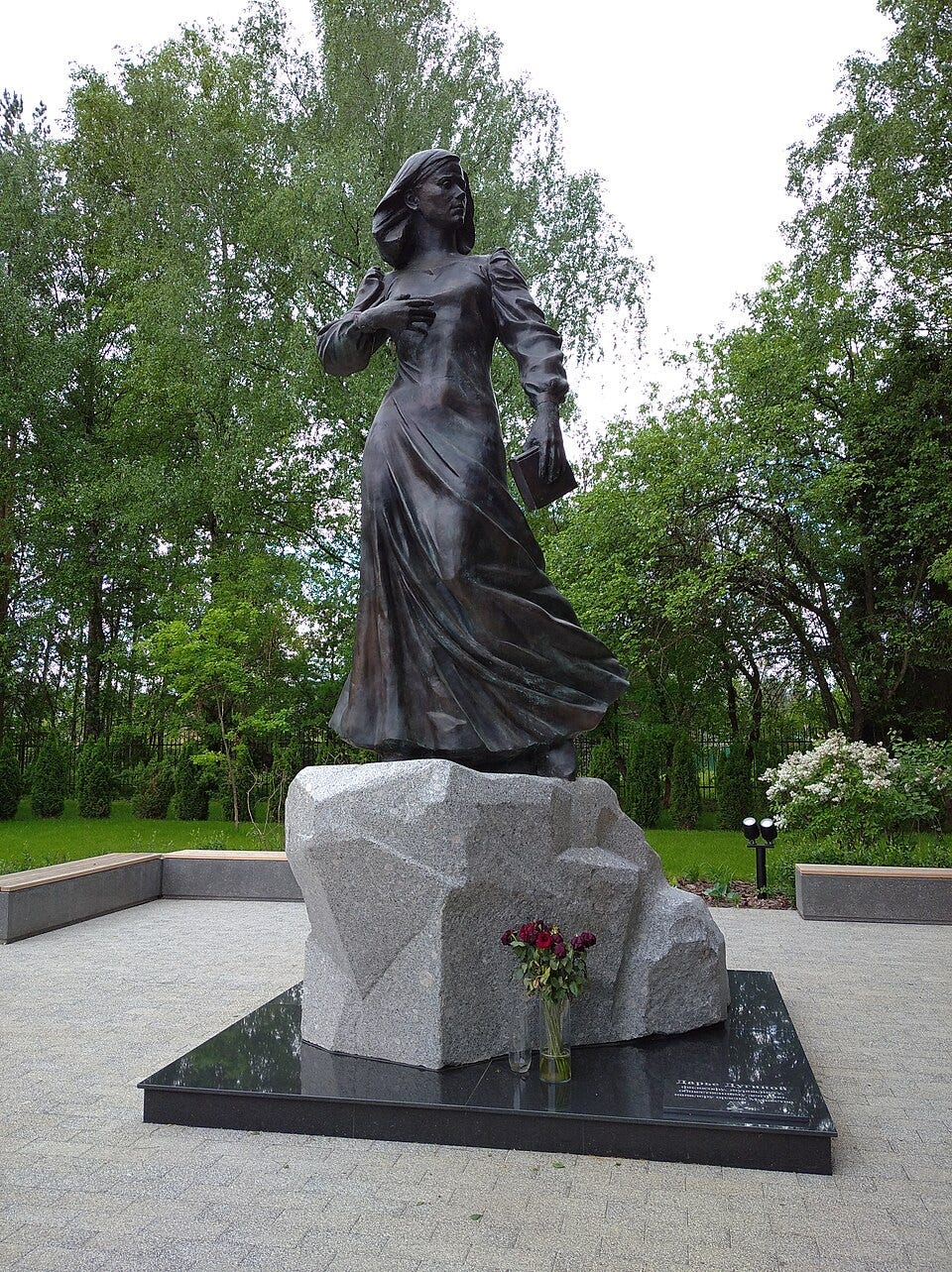
Dasha had many talents and sides to her, but it was philosophy that was foremost for her. If a person manages to find an open entrance into the closed palace of the philosophy, they will never prefer anything else. Dasha found such an entryway. And she forever settled in the closed palace of philosophy.

The festival being held in Dasha’s honor this August has been called Dasha-Aletheia. With this name, the organizers most likely wished to emphasize the philosophical dimension of Dasha’s figure. This time, it is not about her religion, her political worldview, her musical and poetic creativity, or her active patriotism, but namely about philosophy.

I shall try to share some thoughts in this direction.

Heidegger interpreted the Greek word aletheia as “unconcealment” (Unverborgenheit). If truth is unconcealment, then it is concealment that comes first. Truth is never simply given to us. It must be sought out. Truth demands effort, discovery, disclosure, the opening up of revelation. [perseverance] What is primary about Isis is her veil. But Isis’ veil is not a mask, as if we were merely dealing with one subject dressed up as another. No one knows what is truly hidden behind the veil.

The Orthodox world knows the Kikkos Mother of God, an icon which is found in a monastery on Mount Kikkos in Cyprus. This icon is unique in that its face is permanently hidden from human eyes by a special shroud and frame. According to tradition, gazing upon the icon can be dangerous. There is the well-known account of Patriarch Gerasimos of Alexandria, who in 1699 dared to slightly lift the shroud and was immediately struck blind. He was healed only after sincere repentance. According to another account, it is believed that the icon possesses such powerful grace that it is simply dangerous for a person to see it in its entirety.

Likewise, truth, aletheia, is that which it is dangerous to see in full. No one knows what is behind the veil…


When a person dies, they go beyond the veil. One must not disturb the deceased too insistently. One must learn to reverently honor the veil. Therefore, the “unconcealment” of truth is to be understood not as daring to look behind the veil, but as reverently circumambulating it. It is a hermeneutic dance. [To be done in all, in a sacred way...]

If we are to speak of Dasha’s aletheia, about Dasha’s truth, then nearing it demands that we keep some distance.

It is believed that the most poignant texts in history have been written about love. That is probably true. Yet thinkers and poets have reached the pinnacle of their ability to describe emotional pain when they lost their daughters. With respect to the absolute depth of tragedy, nothing compares to Cicero’s Consolatio. It was inspired by the treatise On Grief (Περὶ πένθους) by the Greek Platonist Crantor. Crantor wrote this text as a condolence for his friend Hippocles. Lactantius said very aptly of Cicero — and I could easily apply these words to myself —:

M. Tullius in sua Consolatione pugnasse se semper contra fortunam loquitur eamque a se esse superatam cum fortiter inimicorum impetus retudisset: ne tum quidem se ab ea fractum cum domo pulsus patria caruerit; tum autem, cum amiserit carissimam filiam, victum se a fortuna turpiter confitetur: “Cedo” – inquit – “en manum tollo.”

[Marcus Tullius Cicero] in his Consolatio speaks of how he had always fought against fate and prevailed, such as when he courageously repelled the onslaughts of his enemies; that even when he was exiled from his home and deprived of his homeland, fate did not break him. But when he lost his most beloved daughter, he shamefully admitted defeat to fate: “I give up,” he says, “I throw up my hands.”

John Donne also dedicated one of the greatest works in English and world poetry to the death of his friend Robert Drury’s daughter, Elizabeth. He called it An Anatomy of the World and wrote of the “decay of the world.” After the death of a beloved daughter, the world falls apart at the seams. It is no longer whole; it is fragmented and dispersed in all directions. For a man, nothing can replace the aletheia of his daughter. The world is no more. We are no more. We are no longer what we were.

Her death hath taught us dearly that thou [the world] art

Corrupt and mortal in thy purest part.

The death of one’s daughter lies at the heart of the whole genre of Consolatio. In Russian, the word is uteshenie. In the Russian language, the Holy Spirit, the Third Person of the Holy Trinity, is called the Uteshitel’, the “Consoler” or “Comforter.” Only the Comforter is capable of helping a man endure the most terrible loss.

The Cathars had a ritual called the Consolamentum: kissing the forehead of Sophia, Wisdom, who is the Consolatrix, the Comforter. She is the one in mind in Nerval’s tragic verses:

mon front est rouge encore du baiser de la reine.

my brow is still red with the queen’s kiss.

For Dante, the Comforter was Beatrice.

The remarkable and soulful Princess Vittoria Alliata, who was friends with Daria, has said that Daria belongs to the archetype of Beatrice, to the Maiden-Tradition.

When that which is foremost in importance and beloved has been concealed or has vanished, consolation must be sought in the concealment itself. This is the mystery of the veil. Tradition is beautiful when it exists, but it is a thousand times more beautiful when it does not — yet, against all the odds, we remain faithful to it. Everyone has forgotten; we remember. Everyone has come to terms with Sophia’s departure, but for us this causes unimaginable suffering. We have no need for a world without her light. Only wild pain can comfort us. This is eschatological optimism. [Cultivate the inner communion and act courageously]

Now for some more about the meaning of the term aletheia. For the Greeks, Lethe is the river of oblivion, of forgetfulness, and “a-” is a negative prefix. Thus, a-letheia is remembrance. On this point, we can turn to Plato. In Plato’s teachings, knowledge is anamnesis, that is remembrance or recollection. The soul has a heavenly nature. It finds itself in the body when it falls, descends. It yearns to return to its homeland. If its recollection is strong, then so too is its draw towards the heavens, its longing for light, for eternity, for ideas. According to Plato, this is what defines the philosopher: longing for the heavens, for return. The world of bodies, earthly life, is oblivion. To be living here, one must have forgotten about the true life. But remembrance causes pain. It is nostalgia, which in Greek means the painful memory of a place, of one’s natural place. Pain and remembrance are intertwined. Truth (aletheia) is that which we recall with pain. Thus, once again, the themes converge: we remember Dasha with pain on the day she soared into the sky like a firebird. We recollect the truth. We remember ourselves [as spiritual beings, and then, in such meditation, we can achieve some inner vision or communion with the immortal spirit of Dasha.]

The origins of theater lie in the cult of the hero. The ancient Greeks would gather at a hero’s tomb to honor his memory at a specific time. They would form a circle, sing sacred hymns, don masks, and make offerings. It was believed that the hero’s immortal spirit would, for a brief time, breathe through their lungs, hear through their ears, and soar on the wings of their voices. Dasha is, without a doubt, a true hero. And memory of her is gradually becoming a ritual.

Plato himself founded his school in a grove dedicated to the sacred hero Academus. There, the people of the polis would gather to honor his memory, to provide the opportunity for the hero to look upon this world and breathe its air. It was in the name of the hero Academus that the pious Athenian men held their philosophical discussions. This later became the origin of all the academies of the world. The hero’s name is not forgotten — a-letheia.

So much is connected to Dasha, so much is being linked to her. She was a philosopher; she staged wonderful theater performances; she wrote music and composed poetry. She was a very kind and sincere person. And along with this, she was a person who suffered deeply. Perhaps this was due to her memory of the higher world and her unwillingness to compromise with the heavy determinisms of the lower world.

Dasha’s memory is not dissipating. Our war has yielded many heroes. But Dasha remains special — differentiated — among them. Her feat and her sacrifice are sanctified by the near presence of truth itself.
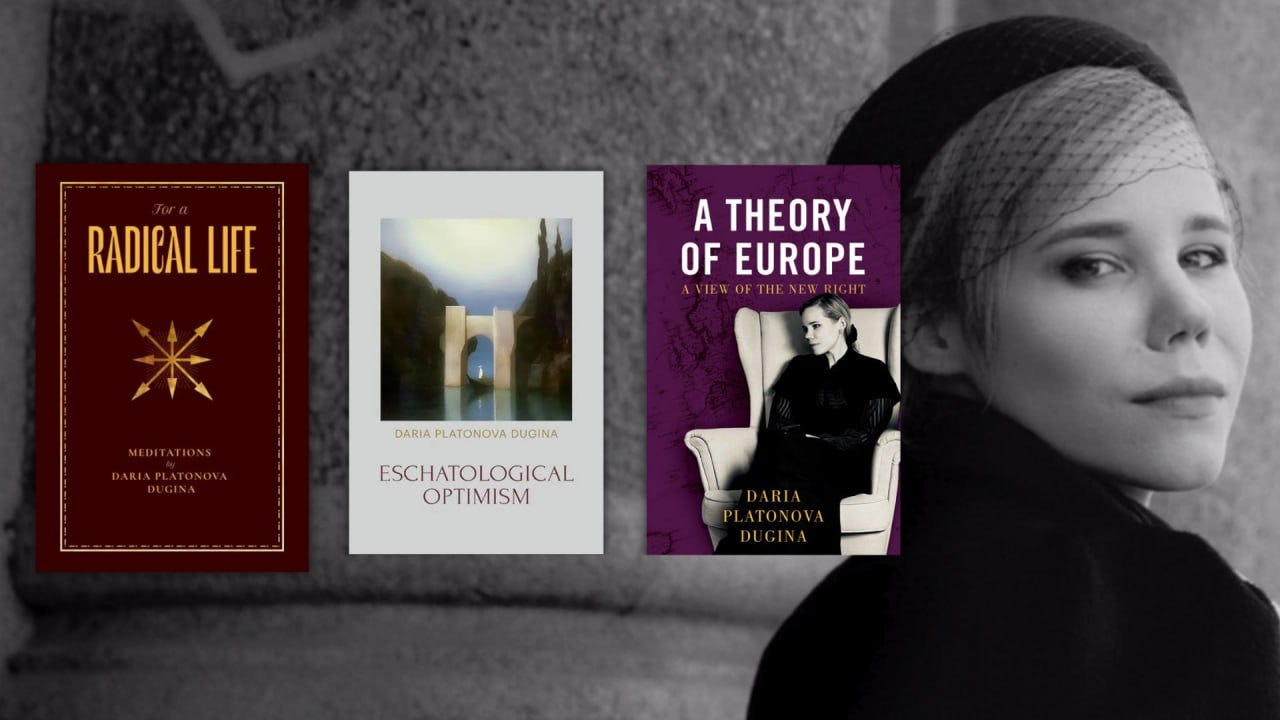


When you think of Dasha, read her books, listen to her voice and her music, and look at her photographs, you realize that the truth is near — within arm’s reach…

There, beyond the thin veil of death…

Cedo, en manus tollo.

Аd caelum tollo.

“I give up, I throw up my hands.”

Up to the heavens.  [Cícero]

— Alexander Dugin,

20 August 2026

The Decline of the West and the Resistance of the New Europe by Daria Platonova Dugina. On the 4º year of his departure from the Earth's physical realm.

On the day of departure of Darya Dugina from the Earth, we share The Decline of the West and the Resistance of the New Europe
by Daria Platonova Dugina

Arktos Journal
Aug 20, 2026

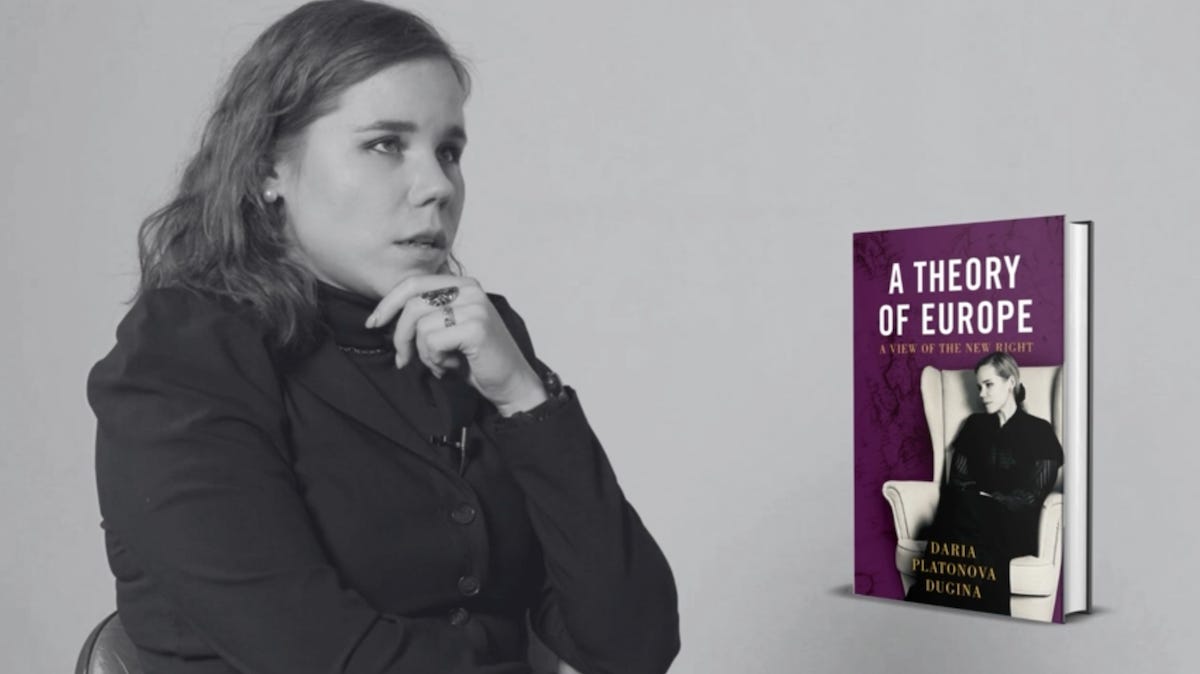
«oday marks four years since the tragic murder of Daria Platonova Dugina, an advocate and translator of the French New Right, friend of leading Nouvelle Droite figures like Alain de Benoist, and the daughter of the Russian Traditionalist philosopher Alexander Dugin.
Last photo of Darya and his father.
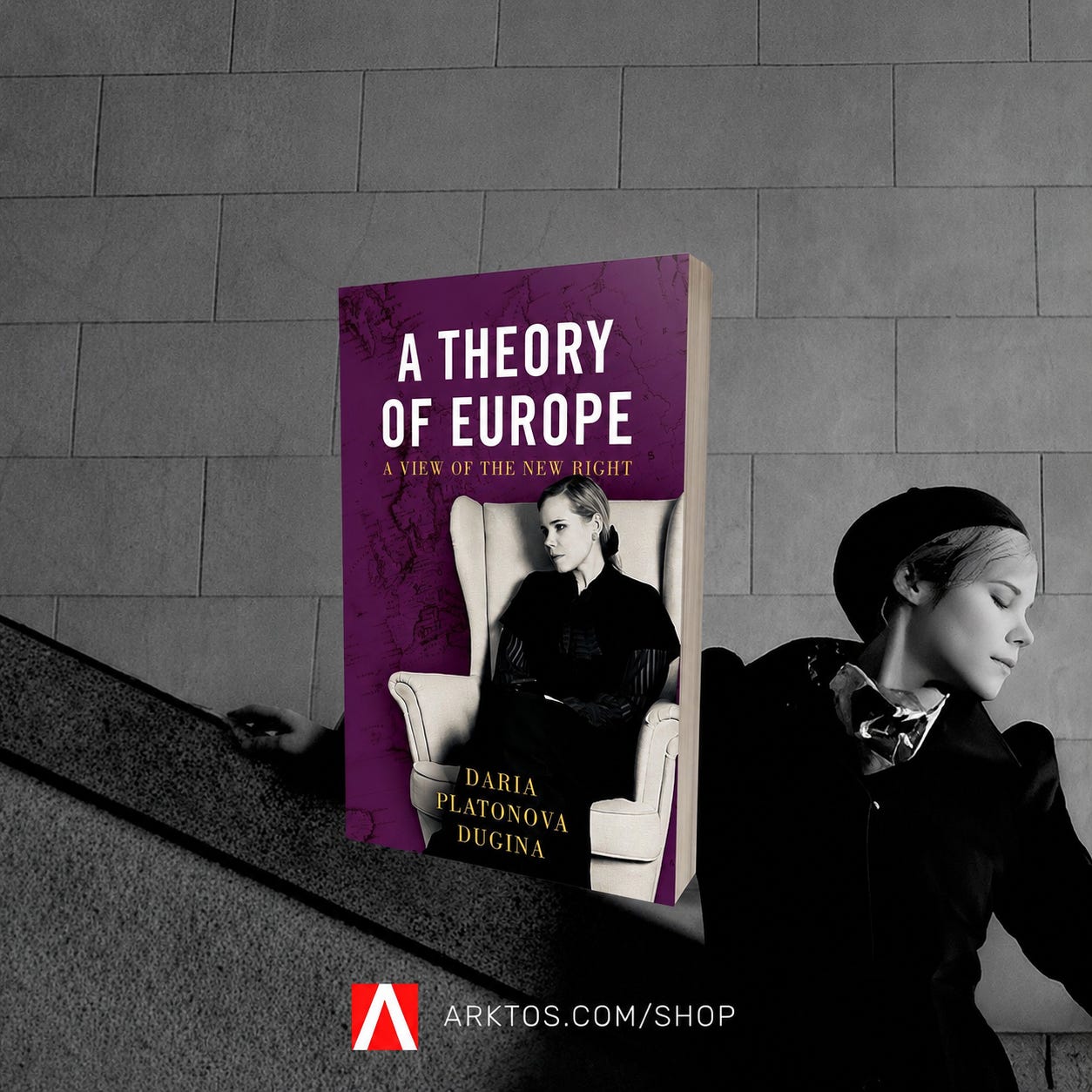
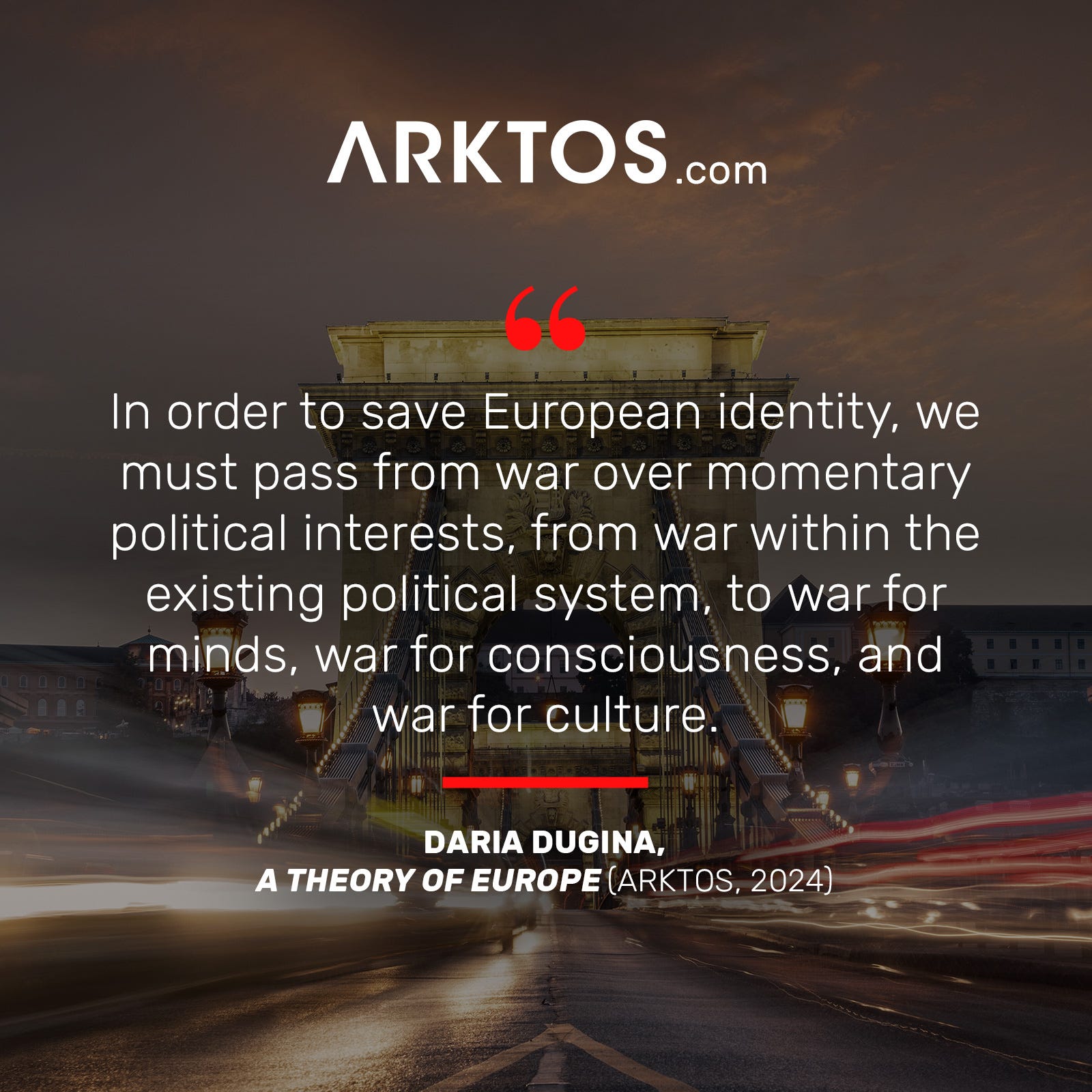
The text below is an excerpt from A Theory of Europe, the posthumously published collection of Dugina’s writings, lectures, and interviews on the Nouvelle Droite and the struggle for a European Renaissance today, brought to you by Arktos. And shared here by the spirit of this blog.

The false impression sometimes arises that politics is not necessary, that metaphysics is the goal and politics is only a rung, but no, this is not at all the case.
If you look at the seventh book of Plato’s Republic as a source, then you’ll see a description of the philosophical process of getting out of the cave, but immediately afterwards Plato, through Socrates, says that what is extremely necessary is in fact to return to the cave, to begin to rule. Because the philosopher is not simply a person who has got out of the cave (the cave of shadows, false opinions, and nihilism), but the one who returns in order to begin passing along his understanding of the Idea of the Good to others.
And so, today is an extremely important day for us, because we are gathering to begin to discuss politics in the spiritual paradigm. My presentation is called “The Decline of the West and the Resistance of the New Europe”.
First of all, we should briefly present the situation today in its eschatological meaning. Let us look at the apostolic prophets, who were already mentioned by Monk Isidor, that is the eschatological prophets who were like those from before the First Coming of Christ, who said that before the End of the World there will be a war between God and the devil that will last a thousand years. We are now living in a phase of war, and in political reality we see many signs of the End Times. I think everyone agrees with me that today we are living in the eschatological sphere that has been most precisely described by religious figures and prophets. But a very similar picture also emerges in the accounts of insightful people working in the sphere of culture, cultural studies, political science, and sociology.
I would like to speak about the outstanding philosopher Oswald Spengler, who ingeniously foretold the end of European civilisation in his renowned work The Decline of the West. It is extremely important that this work’s Italian translation was done by Julius Evola. I think this is symbolic. Of course, I know that you are familiar with these ideas, but I nevertheless want to say a few words about this concept. Spengler argued that Europe has passed from the phase of culture into a new period which he called a period of decline, that is the period of civilisation. In Spengler’s opinion, the death of European civilisation would come in the early 2000s. Now we understand that we really are at this end.
It is also interesting, as some have noticed, that in this case we are talking about the End of the World as a process. It is not a moment, but a process, an “ending end”. The End of the World is a process. This is how it is. In fact, Heidegger said the same of the End of the World and the end of the paradigm of Modernity when he said that the end won’t just arrive, but remains “noch nicht”, that is “not yet” in German. The end is coming, but it doesn’t just come and happen.


In Spengler’s opinion, the advent of totalitarianism in the political sphere is a symbol of the reform of civilisation. He used the term “tyranny”. I would like to say a bit about totalitarianism, because at the present moment we don’t yet have any real tyranny. I would also like to talk about the migration of peoples. This is what we are now observing amidst the decline of European civilisation. Two phenomena are taking place: the migration of peoples and totalitarianism — digital totalitarianism, or the coming of a third, liberal totalitarianism in the sphere of politics.
Today, without a doubt, we live in a world of a new totalitarianism, especially in Europe. This is not at all communist or fascist totalitarianism, but liberal totalitarianism. It is extremely important to point out that liberalism in its essence is just as totalitarian as other totalitarian regimes under communism and fascism. If we return to the eschatological and religious perspective, then we of course see the prospect of liberal totalitarianism sooner or later coming into one pair of hands, to a tyrant. Today, the West is ruled by one man, but he is not sovereign: Trump. Rather, he is a kind of postmodern caricature of a tyrant. A caricature, because he is not a tyrant in the likes of which Plato saw, but rather a simulacrum of a Platonic tyrant.
I’ve worked a lot on covering and analysing the presidential elections in France, and I know well the details of this new totalitarianism. We know that another Satanic figure, one close to the figure of the Antichrist as described by some religious philosophers, Emmanuel Macron, has come to power in a rather strange way, like an algorithm. These were not elections in the direct sense, but really something strange. An invisible force simply appointed Macron to this post without paying any attention to ideology or programme. The bizarre Macron phenomenon is a vivid model of the “third totalitarianism”. I would like to emphasise one wholly noteworthy trait of this personality — the level of development of his theory from the point of view of a philosophical paradigm. If we look at Macron, then we can see that he is really well educated. Despite appearing to have eclectic views, he has his own developed theory and he represents a closed system. He combines right-wing economics and left-wing politics, i.e. an integral right-left liberalism with a big dose of populism. But there is no life in him. If we look closely, we find something technical in all of this, something that is lethally boring.
At the same time, if we look at the philosophy of Marine Le Pen, we discover a fantastic contrast. It may be difficult to recognise a theory, a paradigm, behind her rhetoric and polemics and her contradictory populism which combines right-wing politics and left-wing economics. But if we look more attentively, we’ll catch sight of a fully structured philosophy and clear system standing behind her. On the outside, it seems as though behind Marine Le Pen stands a very vague paradigm, whereas the paradigm behind Macron is really rather differentiated. But we believe that the intellectual weakness that is characteristic of Marine Le Pen, her populism, which at times looks altogether naive, potentially harbours the roots of a new, alternative political philosophy. Why? Because she represents life.
If we use Bergson’s terminology, then we could say that that it is the élan vital (the “vital impulse”, the “energy of life”) that lies at the core of historical and political development. But this impulse doesn’t wield the clearest view of one’s self and surroundings. The vital impulse precedes reflection. The energy of life is blind in its movement, and this is clearly visible in the case of Marine Le Pen. Meanwhile, Macron overall completely represents death, the end of the vital impulse, due to his nihilism, which is a nihilism not from the point of view of Nietzsche, but of Spengler, in the sense of negating all traditional values and hierarchies. Of course, he is against the hierarchy of arms, the order of arms in the state and in metaphysics. He completely rejects the Platonic verticality, the Apollonian axis. In fact, moreover, I think he is even perfectly capable of reinterpreting it in the opposite sense. After all, he not only rejects it, but at times inverts it, brings the matter to an anti-hierarchy, anti-aristocracy, anti-Europe, and anti-France.
Marine Le Pen does not reject traditional values and traditional hierarchies, but she can’t bring herself to unite with them, because if she were to return to them, it would be written off as reactionary or conservative. This wouldn’t be conservatism in the best sense of the word, like the Conservative Revolution, but, to use the terminology of the political scientist René Rémond, would be a kind of “right legitimism”. I’m not certain, but if I have correctly understood Rémond, then I think that this would be a kind of “reactionarity”. Marine Le Pen is defending a new ideology which she doesn’t understand. Her rigidity exists because she doesn’t understand where to go. In fact, she lost, but she lost to the same extent that the people did — she doesn’t understand, but to the same extent that the people doesn’t. So, we can observe a naivety and even intellectual impotence on Marine Le Pen’s part in the face of the well-conceived doctrine that stands behind Macron.
However, if we view this interesting distinction through the prism of Leo Frobenius’ cultural morphology, then we can see an extremely interesting and importance circumstance. Frobenius, a friend of Spengler’s, worked out the doctrine of “captivation” (Ergriffenheit). He said that the personality, culture, and the state are irreproachable in all societies, especially the personality and culture. There are three phases: (1) Ergriffenheit, that is “captivation”, “emotional engagement”, or even “obsession”, (2) “expression” (Ausdruck), and (3) “application” (Anwendung). When we are captivated by something, we are enchanted by it. This is life, the energy of life, the principal of the vital impulse, the principle of creation. This is the first phase of culture, including political culture, and resembles the ideal Platonic position in which the philosopher is “engaged” or “captivated” by the idea, the Idea of the Good, and is enchanted in this state. The second phase, according to Frobenius, is expression. When the “captivation” is given a name, like when ideas of reform are formulated into theories and programmes, this is “expression”. In psychology, this is the cure, i.e. when we have understood our obsession and try to express it, which means that, once we succeed in doing so, the spiritual sickness is overcome. The third phase is the employment (Anwendung) of the vital impulse as expressed in concrete reality, its application. In this third phase of development, culture is completely de-sacralized and is overloaded with technology.
What Yvan Blot once told me in a private conversation is important: Macron is the Gestell, a Heideggerian term which is applied to the civilisation of Modernity, the civilisation of technology. Heidegger uses the term Gestell to designate the “process of the death of the world”. This is a very important notion in Heidegger’s later philosophy. Macron himself, liberal globalism, the paradigm that stands behind Macron is death. This is the third phase of culture according to Frobenius, the phase of application (Anwendung) and technology. It could also be called the “hegemony of the cave”, the cave that has been hermetically sealed off. This is in comparison to the open doctrine of Marine Le Pen, which has no final philosophical shape and is merely a rather approximate contour of a doctrine, one that is blind to its own vitality and its “captivation”. This is very, very important. As we know, Alain de Benoist has called Macron an “algorithm”, that is, a tiny technical detail, a cog in the system, a tiny rock in the cave — after all, Macron’s system is closed shut.
And so the time has come to draw out the comparison with Plato’s cave as described in the seventh book of the Republic. We have two orders, two models. The first model is the closed cave, where the prisoners remain ignorant of the Idea of the Good. This model represents liberal hegemony and the nihilistic dictatorship which Europe lives under today. The second model is the cave with the open possibility of leaving it — this is populism. This is an alternative to the closed system.
The people who are representing Europe today at our colloquium have before themselves the goal of getting out of the cave of nihilism. You are exiting the cave like the philosopher-king who makes it out of the cave of illusion and begins to see the Idea of the Good. Of course, after the darkness of the cave it is always difficult to catch sight of the Idea of the Good; after all, your eyes haven’t got used to the light and are still closed. But this step is extremely important.
Today, we live in a division into two Europes. The first Europe is the closed-off Europe of the cave of nihilism, the dictatorship of nihilism in Plato’s Cave, where all the people are prisoners. The second system, which all of you here today represent, is the system of intellectuals who are getting out of the cave in order to see the Light of the Good, and who return to the people so as to tell them what it is.
Today, the alternative to the cave with no way out, the cave that has a way out to contemplate the Good, is, without a doubt, populism. Populism in our days is a new form of anti-totalitarianism, a struggle to get out of the nihilistic dictatorship of the cave. It is the alternative to liberal hegemony.
It is interesting that today the political division is no longer horizontal, as it was before, as the schism between left and right has ended, but is vertical, so now the actual, relevant schism is above all between the elites and those below, the people. It is important that the representatives of this cave hegemony, the nihilistic cave, necessarily want the people to stay as prisoners at the bottom. After all, they themselves are not philosophers who have made their way out of the cave to govern. They themselves are prisoners of the very same cave, the liberal religion, only on the second floor. To recall, Plato’s cave has three levels, among which the lowest level is the masses subjected to harsh dictatorship, chained by their hands and legs and incapable of turning their heads away from the endless projections on the screen.
We have no ideology in the current conditions. We need to establish, affirm, and develop one. This conference is an invitation to create and develop a new ideology for Europe. We can’t say that we are populists. Populism is only a stage in life, the stage of “captivation”. It is part of the sickness. We are more like psychoanalysts. We are the psychologists of the birth process of a new populism, and we must give a schema, a philosophical paradigm, an explanation, an expression (Ausdruck) to this captivation.
The people are captivated and engaged in the fight against the elites — this is the main idea of populism according to Ernesto Laclau and Chantal Mouffe, the idea of how to direct and wage war against the liberal elites ruling over the people in these new conditions. In line with Frobenius, our role is to give expression to the élan vital, to the blind captivation of the masses, and to interpret the vital impulse of the people.»