quinta-feira, 20 de agosto de 2026

The Decline of the West and the Resistance of the New Europe by Daria Platonova Dugina. On the 4º year of his departure from the Earth's physical realm.

On the day of departure of Darya Dugina from the Earth, we share The Decline of the West and the Resistance of the New Europe
by Daria Platonova Dugina

Arktos Journal
Aug 20, 2026

«oday marks four years since the tragic murder of Daria Platonova Dugina, an advocate and translator of the French New Right, friend of leading Nouvelle Droite figures like Alain de Benoist, and the daughter of the Russian Traditionalist philosopher Alexander Dugin.
Last photo of Darya and his father.
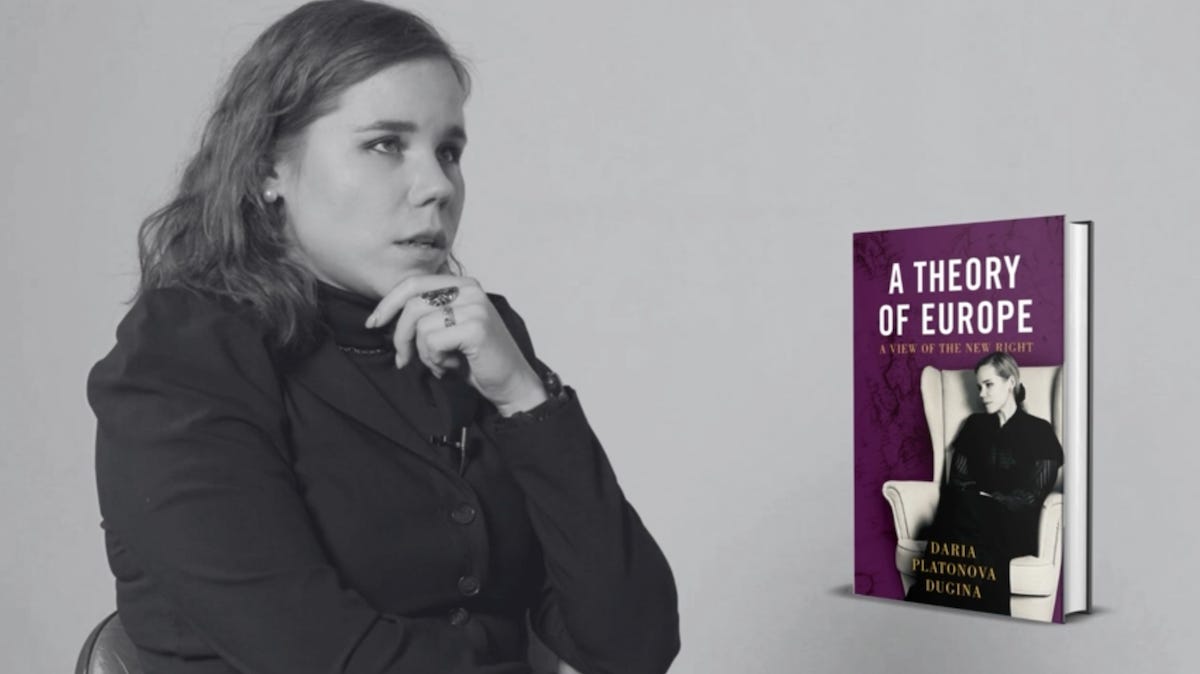
The text below is an excerpt from A Theory of Europe, the posthumously published collection of Dugina’s writings, lectures, and interviews on the Nouvelle Droite and the struggle for a European Renaissance today, brought to you by Arktos. And shared here by the spirit of this blog.

The false impression sometimes arises that politics is not necessary, that metaphysics is the goal and politics is only a rung, but no, this is not at all the case.
If you look at the seventh book of Plato’s Republic as a source, then you’ll see a description of the philosophical process of getting out of the cave, but immediately afterwards Plato, through Socrates, says that what is extremely necessary is in fact to return to the cave, to begin to rule. Because the philosopher is not simply a person who has got out of the cave (the cave of shadows, false opinions, and nihilism), but the one who returns in order to begin passing along his understanding of the Idea of the Good to others.
And so, today is an extremely important day for us, because we are gathering to begin to discuss politics in the spiritual paradigm. My presentation is called “The Decline of the West and the Resistance of the New Europe”.
First of all, we should briefly present the situation today in its eschatological meaning. Let us look at the apostolic prophets, who were already mentioned by Monk Isidor, that is the eschatological prophets who were like those from before the First Coming of Christ, who said that before the End of the World there will be a war between God and the devil that will last a thousand years. We are now living in a phase of war, and in political reality we see many signs of the End Times. I think everyone agrees with me that today we are living in the eschatological sphere that has been most precisely described by religious figures and prophets. But a very similar picture also emerges in the accounts of insightful people working in the sphere of culture, cultural studies, political science, and sociology.
I would like to speak about the outstanding philosopher Oswald Spengler, who ingeniously foretold the end of European civilisation in his renowned work The Decline of the West. It is extremely important that this work’s Italian translation was done by Julius Evola. I think this is symbolic. Of course, I know that you are familiar with these ideas, but I nevertheless want to say a few words about this concept. Spengler argued that Europe has passed from the phase of culture into a new period which he called a period of decline, that is the period of civilisation. In Spengler’s opinion, the death of European civilisation would come in the early 2000s. Now we understand that we really are at this end.
It is also interesting, as some have noticed, that in this case we are talking about the End of the World as a process. It is not a moment, but a process, an “ending end”. The End of the World is a process. This is how it is. In fact, Heidegger said the same of the End of the World and the end of the paradigm of Modernity when he said that the end won’t just arrive, but remains “noch nicht”, that is “not yet” in German. The end is coming, but it doesn’t just come and happen.


In Spengler’s opinion, the advent of totalitarianism in the political sphere is a symbol of the reform of civilisation. He used the term “tyranny”. I would like to say a bit about totalitarianism, because at the present moment we don’t yet have any real tyranny. I would also like to talk about the migration of peoples. This is what we are now observing amidst the decline of European civilisation. Two phenomena are taking place: the migration of peoples and totalitarianism — digital totalitarianism, or the coming of a third, liberal totalitarianism in the sphere of politics.
Today, without a doubt, we live in a world of a new totalitarianism, especially in Europe. This is not at all communist or fascist totalitarianism, but liberal totalitarianism. It is extremely important to point out that liberalism in its essence is just as totalitarian as other totalitarian regimes under communism and fascism. If we return to the eschatological and religious perspective, then we of course see the prospect of liberal totalitarianism sooner or later coming into one pair of hands, to a tyrant. Today, the West is ruled by one man, but he is not sovereign: Trump. Rather, he is a kind of postmodern caricature of a tyrant. A caricature, because he is not a tyrant in the likes of which Plato saw, but rather a simulacrum of a Platonic tyrant.
I’ve worked a lot on covering and analysing the presidential elections in France, and I know well the details of this new totalitarianism. We know that another Satanic figure, one close to the figure of the Antichrist as described by some religious philosophers, Emmanuel Macron, has come to power in a rather strange way, like an algorithm. These were not elections in the direct sense, but really something strange. An invisible force simply appointed Macron to this post without paying any attention to ideology or programme. The bizarre Macron phenomenon is a vivid model of the “third totalitarianism”. I would like to emphasise one wholly noteworthy trait of this personality — the level of development of his theory from the point of view of a philosophical paradigm. If we look at Macron, then we can see that he is really well educated. Despite appearing to have eclectic views, he has his own developed theory and he represents a closed system. He combines right-wing economics and left-wing politics, i.e. an integral right-left liberalism with a big dose of populism. But there is no life in him. If we look closely, we find something technical in all of this, something that is lethally boring.
At the same time, if we look at the philosophy of Marine Le Pen, we discover a fantastic contrast. It may be difficult to recognise a theory, a paradigm, behind her rhetoric and polemics and her contradictory populism which combines right-wing politics and left-wing economics. But if we look more attentively, we’ll catch sight of a fully structured philosophy and clear system standing behind her. On the outside, it seems as though behind Marine Le Pen stands a very vague paradigm, whereas the paradigm behind Macron is really rather differentiated. But we believe that the intellectual weakness that is characteristic of Marine Le Pen, her populism, which at times looks altogether naive, potentially harbours the roots of a new, alternative political philosophy. Why? Because she represents life.
If we use Bergson’s terminology, then we could say that that it is the élan vital (the “vital impulse”, the “energy of life”) that lies at the core of historical and political development. But this impulse doesn’t wield the clearest view of one’s self and surroundings. The vital impulse precedes reflection. The energy of life is blind in its movement, and this is clearly visible in the case of Marine Le Pen. Meanwhile, Macron overall completely represents death, the end of the vital impulse, due to his nihilism, which is a nihilism not from the point of view of Nietzsche, but of Spengler, in the sense of negating all traditional values and hierarchies. Of course, he is against the hierarchy of arms, the order of arms in the state and in metaphysics. He completely rejects the Platonic verticality, the Apollonian axis. In fact, moreover, I think he is even perfectly capable of reinterpreting it in the opposite sense. After all, he not only rejects it, but at times inverts it, brings the matter to an anti-hierarchy, anti-aristocracy, anti-Europe, and anti-France.
Marine Le Pen does not reject traditional values and traditional hierarchies, but she can’t bring herself to unite with them, because if she were to return to them, it would be written off as reactionary or conservative. This wouldn’t be conservatism in the best sense of the word, like the Conservative Revolution, but, to use the terminology of the political scientist René Rémond, would be a kind of “right legitimism”. I’m not certain, but if I have correctly understood Rémond, then I think that this would be a kind of “reactionarity”. Marine Le Pen is defending a new ideology which she doesn’t understand. Her rigidity exists because she doesn’t understand where to go. In fact, she lost, but she lost to the same extent that the people did — she doesn’t understand, but to the same extent that the people doesn’t. So, we can observe a naivety and even intellectual impotence on Marine Le Pen’s part in the face of the well-conceived doctrine that stands behind Macron.
However, if we view this interesting distinction through the prism of Leo Frobenius’ cultural morphology, then we can see an extremely interesting and importance circumstance. Frobenius, a friend of Spengler’s, worked out the doctrine of “captivation” (Ergriffenheit). He said that the personality, culture, and the state are irreproachable in all societies, especially the personality and culture. There are three phases: (1) Ergriffenheit, that is “captivation”, “emotional engagement”, or even “obsession”, (2) “expression” (Ausdruck), and (3) “application” (Anwendung). When we are captivated by something, we are enchanted by it. This is life, the energy of life, the principal of the vital impulse, the principle of creation. This is the first phase of culture, including political culture, and resembles the ideal Platonic position in which the philosopher is “engaged” or “captivated” by the idea, the Idea of the Good, and is enchanted in this state. The second phase, according to Frobenius, is expression. When the “captivation” is given a name, like when ideas of reform are formulated into theories and programmes, this is “expression”. In psychology, this is the cure, i.e. when we have understood our obsession and try to express it, which means that, once we succeed in doing so, the spiritual sickness is overcome. The third phase is the employment (Anwendung) of the vital impulse as expressed in concrete reality, its application. In this third phase of development, culture is completely de-sacralized and is overloaded with technology.
What Yvan Blot once told me in a private conversation is important: Macron is the Gestell, a Heideggerian term which is applied to the civilisation of Modernity, the civilisation of technology. Heidegger uses the term Gestell to designate the “process of the death of the world”. This is a very important notion in Heidegger’s later philosophy. Macron himself, liberal globalism, the paradigm that stands behind Macron is death. This is the third phase of culture according to Frobenius, the phase of application (Anwendung) and technology. It could also be called the “hegemony of the cave”, the cave that has been hermetically sealed off. This is in comparison to the open doctrine of Marine Le Pen, which has no final philosophical shape and is merely a rather approximate contour of a doctrine, one that is blind to its own vitality and its “captivation”. This is very, very important. As we know, Alain de Benoist has called Macron an “algorithm”, that is, a tiny technical detail, a cog in the system, a tiny rock in the cave — after all, Macron’s system is closed shut.
And so the time has come to draw out the comparison with Plato’s cave as described in the seventh book of the Republic. We have two orders, two models. The first model is the closed cave, where the prisoners remain ignorant of the Idea of the Good. This model represents liberal hegemony and the nihilistic dictatorship which Europe lives under today. The second model is the cave with the open possibility of leaving it — this is populism. This is an alternative to the closed system.
The people who are representing Europe today at our colloquium have before themselves the goal of getting out of the cave of nihilism. You are exiting the cave like the philosopher-king who makes it out of the cave of illusion and begins to see the Idea of the Good. Of course, after the darkness of the cave it is always difficult to catch sight of the Idea of the Good; after all, your eyes haven’t got used to the light and are still closed. But this step is extremely important.
Today, we live in a division into two Europes. The first Europe is the closed-off Europe of the cave of nihilism, the dictatorship of nihilism in Plato’s Cave, where all the people are prisoners. The second system, which all of you here today represent, is the system of intellectuals who are getting out of the cave in order to see the Light of the Good, and who return to the people so as to tell them what it is.
Today, the alternative to the cave with no way out, the cave that has a way out to contemplate the Good, is, without a doubt, populism. Populism in our days is a new form of anti-totalitarianism, a struggle to get out of the nihilistic dictatorship of the cave. It is the alternative to liberal hegemony.
It is interesting that today the political division is no longer horizontal, as it was before, as the schism between left and right has ended, but is vertical, so now the actual, relevant schism is above all between the elites and those below, the people. It is important that the representatives of this cave hegemony, the nihilistic cave, necessarily want the people to stay as prisoners at the bottom. After all, they themselves are not philosophers who have made their way out of the cave to govern. They themselves are prisoners of the very same cave, the liberal religion, only on the second floor. To recall, Plato’s cave has three levels, among which the lowest level is the masses subjected to harsh dictatorship, chained by their hands and legs and incapable of turning their heads away from the endless projections on the screen.
We have no ideology in the current conditions. We need to establish, affirm, and develop one. This conference is an invitation to create and develop a new ideology for Europe. We can’t say that we are populists. Populism is only a stage in life, the stage of “captivation”. It is part of the sickness. We are more like psychoanalysts. We are the psychologists of the birth process of a new populism, and we must give a schema, a philosophical paradigm, an explanation, an expression (Ausdruck) to this captivation.
The people are captivated and engaged in the fight against the elites — this is the main idea of populism according to Ernesto Laclau and Chantal Mouffe, the idea of how to direct and wage war against the liberal elites ruling over the people in these new conditions. In line with Frobenius, our role is to give expression to the élan vital, to the blind captivation of the masses, and to interpret the vital impulse of the people.»

quarta-feira, 19 de agosto de 2026

Сеятельные мысли Александра Дугина накануне годовщины перехода Дарьи Дугиной Платоновой в духовный мир

Накануне годовщины убийства Дарьи Дугиной Платоновой (20-8-22), её отец, Александр Дугин, как геополитический стратег, а также как платонический философ и традиционалист-православный христианин, поделился ценными оригинальными мыслями, которые помогут нам лучше понять, что происходит на мировой арене и в войне, и соприкоснуться с ним и его дочерью Дарьей, с Россией и христианской и духовной традицией человечества. Вот они:

«Трамп абсолютно недоговороспособен. Он представляет собой само олицетворение недоговороспособности. Это epic fail во всем. Но это не страшно. Если мы трезво понимаем, с кем имеем дело, мы найдем выход. Только не надо иллюзий. Дело не в Трампе - дело в Западе как таковом. Попытка примкнуть к нему всегда в русской истории оканчивалась крахом. Эпохи противостояния с ним приводили к нашему взлету. Страшно не само зло, страшен переход на его сторону человека. Запад не геополитическая, а метафизическая, религиозная, духовная проблема. Это проблема чистого зла. Человек свободен выбирать: между добром и Западом. Выбирая Запад, человек предает себя, свою душу, Отечество, и в конце концов Бога.

Запад не всегда был таким, но он постепенно таким стал. Это его судьба. На западе заходит солнце, туда прежде начала времени или в самый первый миг рухнул молнией сатана. Даже часть ангелов в какой-то момент выбрала Запад. И рухнула. «Падет от страны Твоей тысяча и тьма одесную Тебе.»


Трамп показался на мгновение шансом самого Запада - крайнего Запада - свернуть со своей фатальной траектории, ведущей в бездну. Но ничего не получилось. Это было иллюзией. И вероятно, ещё одним обманом, ещё одной уловкой, ещё одним соблазном. Чего ещё можно было ожидать от отца лжи и человеконенавистника Запада?!
Дьявола невозможно убить, но это не значит, что ему надо сдаваться. С ним надо сражаться. До последнего. Победа даруется Богом. Тому, кто остается на Его стороне не смотря ни на что. Это наша русская судьба. Запад наш враг. Пока он есть то, что есть. Изменится, мы подумаем. И если это окажется искренним, порадуемся. Но пока война.
Вот почему неприемлем «дух Анкориджа». Не сам Анкоридж, а именно «дух». Это злой дух, дух предательства. Доверять Западу нельзя.
А Трамп вообще недоговороспособен. Уравнение сошлось.»


«Вчера в программе Эскалация на Спутнике я постарался зафиксировать одно важное методологическое положение: мы (почти) всегда (почти) все делаем с опозданием. По меньшей мере все хорошее, все плохое почему-то напротив довольно быстро. Если следовать этому, то придется критиковать каждый шаг и запутываться все дальше и дальше, потому что никто слушать ничего не желает и продолжают запаздывать.
Но если наложить мораторий на этот аргумент скорости и оценивать только направление, его вектор, то картина сразу повеселее станет. С огромным опозданием, но при Путине мы все делаем правильно. По вектору. Почти не отступаем. Почти. И продолжаем давить, если и отступаем. Не бросаем и не опускаем рук. Никогда.
Все трясут, почему так медленно, но если убрать этот тайминг, то картина станет довольно приемлемой и даже обнадеживающей. Это как циклы большой размерности. Меркурий снует вокруг солнца как бешеный, а Сатурн движется мерно и неспешно. Будто застыл, приклеился. Но это иллюзия - он идет своим путем по своей траектории. Мы не Меркурий точно. Что-то ближе к Сатурну.»

»Слушайте, идет война. Более того, мы только подходим к ее полноценному началу. Пришло время ударить по территории стран НАТО. Это можно откладывать, но нельзя избежать. Поэтому удар будет. Он состоится.
Но и сейчас полстраны уже живет в войне в постоянном режиме. Конечно, теперь что-то будет отключаться, что-то ограничиваться, что-то падать, что-то взрываться. Погибнуть в любой момент может каждый. Безопасных зон больше нет. И отныне не будет.
Бензина не хватает... Это важный повод подумать, так ли важно нам быть там, куда мы рвемся. Это вопрос жизни и смерти? А на войне все вопрос жизни и смерти. В бытии человека все должно быть вопросом жизни и смерти.
Спокойнее надо ко всему относиться: мы все на фронте. Давайте сосредоточимся на том, что каждый из нас в этот конкретный момент сделал для Победы и что может и собирается сделать в каждый следующий момент. И зачем каждый живет на земле. Важный вопрос. Если нам на все наплевать - на смыслы, на страну, на Победу, то бензина нам вообще не стоит давать. Вообще ничего не стоит. Так живет моль. Не люди, а насекомые. Даже по карточкам интернета не стоило бы раздавать. Вначале ответ: в чем смысл жизни, брат? А то может ты и не брат вовсе. Если для тебя смысл жизни в комфорте и услугах. И думать ты не хочешь. Ты не хочешь, и о тебе никто думать не станет. Вот как-то так...»


«С Преображением Господним! В этом празднике сосредоточена вся суть христианского учения. Господь Исус Христос есть Превечный Бог. И Его Свет нетварен. Те, кто сподобились созерцать этот Свет в своем сердце, выходят по благодати за пределы самого творения. На этом построен исихазм, самое внутреннее и таинственное измерение православной традиции.

Да будет так, и да примем Свет Логоса, и будем созерцать его духовным взором и ощущать в наших сердцах, живя им с мужеством и радостью, доxa, ананда, хварнат (хваренах).

Seed thoughts fom Alexander Dugin, on the eve of the anniversary of Daria Dugina Platonova's passing into the spiritual world

On the eve of the anniversary of Daria Dugina Platonova's assassination (20-8-22), her father, Alexander Dugin, as geo-political strategist, and as Platonic philosopher and traditionalist Orthodox Christian, shared some valuable original thoughts that will help us to understand better what is happening on world stage and war, and to commune with him and his daughter Daria, with Russia and the Christian and Spiritual Tradition of Humanity. Here they are:
                          
«Trump is absolutely untrustworthy. He is the very embodiment of being uncooperative. It's an epic fail in everything. But that's not a big deal. If we understand soberly who we are dealing with, we will find a way out. Just no illusions, please. It's not about Trump—it's about the West as such. The attempt to join him has always ended in failure in Russian history. The eras of confrontation with him led to our rise. It is not evil itself that is frightening, but the transition of a person to its side. The West is not a geopolitical, but a metaphysical, religious, spiritual problem. This is a problem of pure evil. A person is free to choose: between good and the West. By choosing the West, a person betrays themselves, their soul, their homeland, and ultimately God.
The West was not always like this, but it gradually became so. It is its fate. In the west, the sun sets; there, before the beginning of time or in the very first moment, Satan fell like lightning. Even a part of the angels chose the West at some point. And fell. "A thousand may fall at your side, and ten thousand at your right hand."
For a moment, Trump seemed to be the chance for the very West—the far West—to divert from its fatal trajectory leading into the abyss. But nothing worked out. It was an illusion. And probably, yet another deception, another trick, another temptation. What else could one expect from the father of lies and the misanthrope of the West?!
The devil is impossible to kill, but that doesn't mean we should surrender to him. You have to fight him. To the last. Victory is granted by God. To those who remain on His side no matter what. This is our Russian fate. The West is our enemy. For now, it is what it is. It will change, we'll think about it. And if it turns out to be sincere, we will rejoice. But for now, there is war.
That's why the "spirit of Anchorage" is unacceptable. Not Anchorage itself, but the "spirit." This is an evil spirit, a spirit of betrayal. You can't trust the West.
And Trump is completely incapable of making agreements. The equation has balanced.»
«Yesterday on the program Escalation on Sputnik, I tried to highlight one important methodological point: we (almost) always (almost) do everything with a delay. At the very least, all the good things, and all the bad things, for some reason, happen quite quickly. If we follow this, we will have to criticize every step and get more and more entangled, because no one wants to listen and they continue to be late.
But if we impose a moratorium on this speed argument and evaluate only the direction, its vector, then the picture will immediately become much brighter. With a huge delay, but under Putin, we are doing everything right. Along the vector. We almost never retreat. Almost. And we keep pushing, even if we retreat. We don't give up and we don't lower our hands. Never.
Everyone is shaking their heads, wondering why it's so slow, but if you remove this timing, the picture becomes quite acceptable and even hopeful. It's like high-dimensional cycles. Mercury darts around the sun like a madman, while Saturn moves steadily and unhurriedly. As if frozen, stuck. But that's an illusion - he is following his own path on his own trajectory. We are definitely not Mercury. Something closer to Saturn.»
«Listen, there is a war going on. Moreover, we are only approaching its full onset. The time has come to strike the territory of NATO countries. This can be postponed, but it cannot be avoided. Therefore, the blow will come. It will happen.
But even now, half the country is already living in a constant state of war. Of course, now something will be shut down, something will be restricted, something will fall, something will explode. Anyone can die at any moment. There are no more safe zones. And there won't be any from now on.
There's not enough gasoline... This is an important reason to think about whether it is so important for us to be where we are rushing to. Is it a matter of life and death? But in war, everything is a matter of life and death. In human existence, everything should be a matter of life and death.
We need to take everything more calmly: we are all on the front lines. Let's focus on what each of us has done for Victory at this very moment and what we can and will do in every subsequent moment. And why does everyone live on this earth? An important question. If we don't care about anything—about meanings, about the country, about Victory—then we shouldn't be given any gasoline at all. It’s not worth anything at all. That's how a moth lives. Not humans, but insects. Even by internet cards, it wouldn't be worth distributing. At first, the answer: what is the meaning of life, brother? Otherwise, maybe you're not a brother at all. If for you the meaning of life is in comfort and services. And you don't want to think. You don't want to, and no one will think about you. That's just how it is...»


«With the Transfiguration of the Lord! In this feast, the essence of Christian teaching is concentrated. The Lord Jesus Christ is the Eternal God. And His Light is uncreated. Those who have been deemed worthy to behold this Light in their hearts transcend, by grace, the very bounds of creation. This is the foundation of hesychasm, the most inner and mysterious dimension of the Orthodox tradition.
This is the core of Russian philosophy, as the philosophy of Transfiguration

May we and receive the Light of the Logos, and contemplate it with our spiritual eye and feel it in our hearts, living it with courage and joy, doxaananda, xvarnat (khvarenah).

Prefácio de Alexander Dugin , 2ª p., ao "Optimismo Escatológico", da sua filha Daria Dugina Platonova.

Continuamos com a segunda e última parte do valioso prefácio de Alexandre Dugin ao excelente e tão desafiante livro de Daria Dugina Optimismo Escatológico. A 1ª parte do prefácio traduzido está em https://pedroteixeiradamota.blogspot.com/2025/08/a-homenagem-1-parte-de-alexander-dugin.html

  Optimismo Escatológico: Para uma Teoria

«O tema principal deste livro, que contém os ensaios filosóficos de Daria Dugina, é o "optimismo escatológico," conforme se declara no título. É melhor seguir  a própria Daria , pois ela tenta definir essa noção não em termos estritamente racionais, mas empiricamente e fenomenologicamente, compartilhando a sua experiência de viver e experimentar essa ideia e convidando aqueles que são atraídos por essa experiência. Num certo sentido, Daria é a autora do conceito de "otimismo escatológico" como tal. Não importa se a encontramos entre os seus autores favoritos (Cioran, Evola, Jünger) ou se a imaginamos como algo original e pioneiro que nos levaria a ler teorias filosóficas e culturais de uma perspectiva totalmente específica. A questão não está nas palavras, mas em como certos termos, expressões ou frases se tornam um método, um meio de decifrar, uma base para interpretar.
"O otimismo escatológico" é um paradoxo. É uma combinação de fatalismo condenado e o triunfo do livre arbítrio, uma experiência aguda do colapso do mundo e fé na vitória do espírito, uma fé que se torna ainda mais ardente pelo fato de não ter confirmação. O optimista escatológico é capaz de sintetizar e experimentar duma vez e ao extremo o mais alto grau de desespero, bem como uma esperança alegre e consumidora. O fim do primeiro é o começo do segundo. A dor do fim é a alegria de um novo começo. Mas nós, como humanos pertencentes a dois mundos simlutaneamentee, não devemos evitar sofrer o destino deste mundo. O nosso chamamento é sofrer junto a ele, ao lado do seu colapso, sua imperfeição e suas perversões e deslizar para o abismo. O ser humano é uma criatura que sofre. Isso não pode ser evitado. Afinal, esse é o nosso destino, nosso fado. Caso contrário, por que nosso Deus teria sofrido na cruz? Ele sofreu, e isso significa que devemos fazer o mesmo. Este mundo já é o fim de um mundo, e essa dor permeia todas as suas estruturas, todas as suas camadas, todos os seus níveis. Se estivermos atentos, então leremos nessas páginas como o ser sofre, como o universo chora. Suas lágrimas são nossas almas, nossos pensamentos, nossos sonhos laboriosos.

Mas há outro lado das coisas. O céu eterno está tão longe, tão inacessível, tão inalcançável, no entanto, ele está dentro de nós. Para ser mais preciso, se formos extremamente ávidos por experimentar aquilo que não está dentro de nós, se formos construir as nossas vidas em torno dessa perfuração ontológica, desse buraco negro, então um dia uma nova estrela nascerá dentro de nós — a estrela do reino oculto, a luz  "não-crepuscular" da ressurreição. Então, diante de um certo movimento da dor, quase imperceptivelmente para o próprio optimista escatológico, a escuridão se transformará em luz. O céu estará ao alcance das mãos, inesperadamente e abruptamente, como uma explosão.

                                 Platonismo e Cristianismo.

Daria Dugina era uma filósofa platónica, uma platónica. A isso devemos acrescentar: ela era uma filósofa platónica cristã ortodoxa. Criada desde a infância nas ideias dos Tradicionalistas (René Guénon, Julius Evola, Mircea Eliade e seus seguidores), bem como na cultura cristã ortodoxa (Daria, como nós, seus pais, pertencemos ao Edinoverie e ao Rito dos Velhos Crentes da tradição da Igreja Ortodoxa Russa), Daria descobriu Platão e os Platónicos no início dos seus estudos na Faculdade de Filosofia da Universidade Pública de Moscouvo. Tudo começou com Dionísio, o Areopagita, o auge do Platonismo Cristão. O "Areopagitismo"  tornou-se a sua estrela guia, permitindo-lhe conectar a teologia cristã ortodoxa com o universo platónico. Quanto mais aprofundava os  seus estudos de Platonismo, mais ela descobria uma conexão orgânica com a Ortodoxia e com o Tradicionalismo. Os próprios filósofos tradicionalistas [Guénon, Evola] mencionavam Platão apenas de passagem, sem dedicar muita atenção a ele. No cristianismo, após os julgamentos apressados e intelectualmente controversos feitos sobre Orígenes na era de Justiniano, uma desconfiança constante dos ensinamentos de Platão estabeleceu-se. O próprio facto de que a fundação da teologia cristã — a Ortodoxia — na sua terminologia, conceptualização, estrutura, significado, orientação, etc., foi desenvolvida pela escola de Alexandria e seus sucessores diretos, os Pais Capadocianos (os representantes mais vibrantes do Platonismo Cristão), levou-a  ficar sob a sombra dos ásperos ataques anti-platónicos. Claro, essa questão foi agravada pelos Monofisitas, pelos Monotelitas e, posteriormente, pela busca teológica evidentemente mal-sucedida do discípulo de Miguel Psellos, João Itálico. Finalmente, na polémica palamita, os oponentes de São Gregório Palamas, Barlaam e Akindynos, tentaram fundamentar a crítica ao hesicasmo [ascetismo e devoção dos monges ortodoxos] referindo-se a Platão. No entanto, se olharmos mais profundamente e abstrairmos dessas vicissitudes históricas, nas quais o contexto cultural e até político desempenhou um grande papel que não estava diretamente ligado ao mundo das ideias, então a unidade da sintonia, verticalidade e a devoção incondicional ao céu, à eternidade e aos horizontes superiores do ser aproxima o platonismo do cristianismo sem qualquer dúvida. Os primeiros apologistas cristãos estavam bem cientes disso, e o Capadociano São Basílio, o Grande, a suprema autoridade da Ortodoxia Cristã (e, de fato, era um seguidor de Orígenes, cujos textos ele compilou nos primeiros volumes da Filocália ao lado de seus associados São Gregório, o Teólogo, e Gregório de Niza), instou os cristãos a familiarizarem-se com as obras dos mestres helénicos. Finalmente, se voltarmos aos originais gregos, os textos areopagíticos [do pseudo-Dionísio Aereopagita]  são às vezes simplesmente indistinguíveis das obras de Proclo e da sua escola.
Quando Daria descobriu isso, ficou completamente capturada  pelo Platonismo e, de muitas maneiras, inspirou aqueles próximos e amados por ela — naturalmente, filósofos — a dedicarem-se a estudos aprofundados do Platonismo.
Além disso, Daria notou a surpreendente proximidade entre Platão, os Neoplatonistas e os Tradicionalistas Europeus, entre os quais ela descobriu uma completa unidade de ontologias: os Tradicionalistas haviam descrito uma ontologia que é aproximadamente e polemicamente oposta à das ontologias fragmentárias e distorcidas da Modernidade, e os Platónicos tinham uma ontologia extremamente desenvolvida, detalhada e plenamente exposta, não pior do que a indiana do Advaita-Vedanta. Daria, assim, descobriu a possibilidade de expandir essencialmente a linguagem do Tradicionalismo, na medida em que podemos incorporar plenamente o Platonismo como uma versão completamente correcta da metafísica tradicional na filosofia tradicionalista. Para aqueles que entendem o significado da linguagem, esta é simplesmente uma descoberta incrivelmente significativa.
Em forma condensada, todas essas considerações estão contidas neste livro, Optimismo Escatológico, no qual o Platonismo é tratado e referenciado em uma secção inteira, bem como ao longo dos vários textos e discursos compilados neste volume. 

 O pensamento de Daria sintetiza harmoniosamente e subtilmente o Cristianismo Ortodoxo, o Tradicionalismo e o Platonismo, fortalecendo e reforçando o que é paradigmaticamente comum entre eles, em vez de colocá-los em contradição e conflito. Daria até trata Juliano, o Apóstata, no contexto do Platonismo político e da metafísica do Império — a base da missão Katechontic do Imperador na compreensão cristã pura — em vez de no sentido de uma restauração politeísta. Esta é uma jogada ousada, mas está fundamentada em toda a estrutura de sua visão filosófica de mundo. Não é uma tentativa de revisar a tradição cristã ortodoxa, que para Daria foi até o fim a mais alta e única verdade, mas sim uma chamada de atenção para a semelhança paradigmática da estrutura — e isso é uma questão completamente diferente.

                                      O Pobre Pequeno Sujeito

Daria Dugina dedicou muita atenção ao problema do sujeito. Mesmo na sua juventude, ela percebeu, de forma bastante ingénua, mas com uma precisão surpreendente, que um sujeito fraco predomina na cultura russa, em nossa sociedade e em nosso povo. Ela chamava isso de "sujeito pobre" ou até mesmo "sujeito pobrezinho". Para ser honesto, até brincamos com ela sobre isso. Afinal, apesar de toda a correção de tal discernimento, achamos que não valia a pena insistir nisso. Mas essa ideia fascinava Daria, e ela repetidamente voltava a essa formulação. De uma maneira feminina, ela sentia pena deste "pobre sujeito russo" que era tão terno, indefeso e desajeitado, mas tão querido, afim e amado. Daria podia simpatizar e compartilhar a dor de outra pessoa. Mesmo quando não havia ninguém perto que merecesse cuidado e compaixão, ela conseguia encontrar alguém. O conceito de "pobre sujeito" tornou-se a expressão desse profundo sentimento de sua alma. Ela não sentia pena de alguma pessoa ou criatura, mas de um conceito, uma ideia. A dela era uma pena profunda, espiritual, filosófica.

Este conceito condicionou seu caminho de muitas maneiras. Por um lado, ela sentia que em nenhum outro senão no "pobre sujeito" reside algum tipo de verdade difícil de formular, alguma revelação oculta, algum tipo de verdade difícil, trágica, dolorosa. Os protagonistas de Pushkin eram para ela incrivelmente claros, especialmente Samson Vyrin de O Mestre de Estação, ou Evgeny em O Cavaleiro de Bronze, o louco Akaky Akakievich em O Casaco de Gogol, ou o bêbado Marmeladov em Crime e Castigo. Por trás da fraqueza dos russos comuns e fracos incapazes de se defenderem, Daria apagou a sua banalidade e adivinhou sua grandeza oculta, a sua fidelidade heróica a alguma verdade oculta e não dita e uma mensagem secreta e misteriosa da Rússia para o mundo. Claro, os russos são fracos, débeis e loucos, mas há algo mais dentro deles, e esse algo mais ressoa de forma penetrante e aguda para aqueles cujos ouvidos estão sintonizados com a onda russa. Daria amava o "pobre sujeito", porque apenas uma mulher, na  sua ternura sem limites, inesgotável e piedosa, na infinidade de sua compaixão, em seu sacrifício, em sua majestade puramente feminina, tão inacessível ao outro sexo, pode amar tal sujeito.
Ao mesmo tempo, Daria carregava dentro de si a vontade de um sujeito forte, firme, corajoso, heroico. A fraqueza e a pobreza da Rússia despertaram nela um desejo desenfreado de compensar e conquistar isso com sua própria força. Um sujeito poderoso, de vontade forte, profundo e ativo deve nascer não contra, mas a partir de tal fraqueza. O que é de suma importância é não se tornar como o intelectualismo frio do Ocidente, que não conhece nem compaixão nem piedade, é surdo à fraqueza e à pobreza, e é arrogante e individualista. Não é isso que a força russa representa; não é assim que o sujeito russo deve ser construído. O sujeito russo deve ser forte em sacrifício, corajoso em servir ao todo — ao povo, ao estado, à Igreja — e profundo e sábio não para se gabar, mas para transmitir a luz vista nas alturas da contemplação aos outros, aos infelizes prisioneiros no fundo da caverna. Um sujeito forte, um herói russo, é antes de tudo um sacrifício. Esta vítima sacrificial sabe que seu destino é trágico, que seu caminho é de sofrimento, mas ele escolhe conscientemente esse caminho e não deseja outro para si.
Daria cultivava vontade, intelecto e uma subjetividade profunda, firme, poderosa e heroica. Essa foi sua escolha consciente. Mas esse poder que ela acumulou e se obrigou a cultivar dentro de si não era originalmente para ela sozinha. Em virtude de algum tipo de fatalidade surpreendente, ela sabia que estava destinada a tornar-se uma heroína, a sacrificar-se pelo bem do povo e da Ideia Russa. Sua subjetividade forte e poderosa estava deliberadamente orientada para se entregar à fraqueza, para acender com seu próprio fogo a corrupção dos fracos pequenos sujeitos de uma sociedade semi-viva, para que eles fossem inflamados e preenchidos com seu poder, que se tornaria o deles.
                                  

 Quem poderia imaginar que esse fogo seria a chama do carro de uma jovem filósofa explodido por inimigos quando ela voltava do pacífico Festival da Tradição na propriedade de Pushkin em Zakharovo. Mesmo falar sobre isso é horrível, mas ela e ninguém mais viu o caminho do herói que ela sempre quis se tornar.

O Feminismo de Daria Dugina

Para Daria, a questão do sexo e do género era de grande importância. Seguindo a filosofia do Tradicionalismo e, acima de tudo, a Metafísica do Sexo de Julius Evola, ela foi criada com a ideia de que homem e mulher representam dois mundos metafísicos. Nenhuma analogia direta entre eles é confiável. Cada detalhe, para não mencionar algo mais, carrega um significado diferente, um propósito diferente, uma forma diferente e uma substância diferente no mundo do homem e no mundo da mulher. Daria via nisso a riqueza do ser. Basta aceitar isso, e em vez de um universo, dois se abrem diante de nós. A relação entre eles não é de forma alguma redutível à lógica plana de poder/subordinação, completude/falta, direcionalidade/ curvatura, presença/ausência, etc. Tudo é muito mais complicado, pois cada mundo tem a sua própria dimensão, a sua própria topologia, as suas próprias estruturas semânticas, as suas próprias línguas e dialetos. Daria pôs-se a simesmo seriamente a pergunta sobre a língua das mulheres. Afinal, mesmo quando estão entre si, as mulheres continuam a falar a língua dos homens. Somente em momentos raros — e acima de tudo quando estão sozinhas com bebés — é que os sons e sílabas profundamente ocultos das mulheres emergem. São relíquias de uma língua materna primordial, esquecida e perdida, submersa nas profundezas do inconsciente.
Daria interessou-se pelo feminismo, e uma das secções de Optimismo Escatológico é dedicada a esse tema. Aqui, Daria depara-se com um dilema. O desejo das mulheres de manter a sua soberania diante da masculinidade tóxica é compreensível. Há algo de justificado nisso. Afinal, uma mulher não é uma coisa, não é uma escrava, não é propriedade, não é uma criatura de segunda classe, e não é uma tola incorrigível — tal é a visão masculina que, na verdade, é característica de um tipo inferior de homens rudes, carnais e primitivos. Quanto mais elevado o homem, mais atencioso ele é com o feminino e mais delicado e subtil. Mas a justa colocação da questão da dignidade feminina quase nunca ou extremamente raramente é trazida à tona no feminismo moderno. As feministas  frequentemente escorregam para um dos três extremos: exigem a completa igualdade com os homens (e, ao tomarem os valores do mundo masculino como critérios para a norma, acabam abolindo o seu próprio sexo e simplesmente se tornam "homens"); estabelecem o matriarcado, que apenas parodia a brutal dominação dos homens; ou clamam pela abolição do sexo como um todo, como algo deliberadamente portador de desigualdade, e defendem os ciborgues assexuados.
Daria acredita que isso não está certo. Deve haver outra saída. Ela encontra-a na perspectiva de um feminismo que insiste na autonomia dos dois mundos, masculino e feminino, masculino e feminino. Não deve haver prescrições para o mundo feminino. Uma mulher fiel à sua natureza pode escolher e provavelmente escolherá o serviço a Deus no monasticismo, o serviço à família, aos filhos, a um homem maravilhoso e heróico, a uma ideia, a uma causa, à afirmação de valores superiores. Ao fazer isso, ela não trai o seu sexo, mas permite que a riqueza infinita inerente à sua natureza sexual se revele. O mais alto destino de uma mulher, assim como de um homem, como disse o amado Platão de Daria, é ser filósofo. Claro, a mulher é mais fraca e carregada de muitas preocupações, mas isso só significa que ela deve trabalhar mais em si mesma, acompanhar tudo e se tornar ainda mais forte, mais forte do que suas fraquezas, e então as suas fraquezas se tornarão suas forças, e a sua superfície se tornará sua profundidade (como acreditava Nietzsche). Este é um feminismo completamente diferente — o feminismo de Daria Dugina, que é bastante compatível com a Ortodoxia, o patriotismo e a reverência pela família.
 O Pós-moderno ao Ataque
Daria Dugina estava interessada na filosofia contemporânea, especialmente na Pós-Modernidade e no Pós-Modernismo. Claro, a sua verdade estava noutro lugar — na Tradição, na Ortodoxia e no Platonismo — mas alguns aspectos da Pós-modernidade a fascinavam-na. Daria estudou bastante profundamente Lacan, Deleuze e a ontologia orientada a objetos. Uma secção inteira do Optimismo Escatológico é dedicada a esses estudos.

Daria estava fascinada pelo topos emaranhado da Pós-modernidade que transformou o discurso filosófico numa charada irônica que, à medida que se desenrolava, não via os significados a serem esclarecidos e acumulados, mas sim tornados mais obscuros, extintos, piscando na periferia mais distante, mergulhados num completo e corpóreo despropósito. Para Daria Dugina, a filosofia pós-moderna e a ontologia orientada por objetos são o domínio da demonologia filosófica, análoga às lendas medievais dos milagres negros de feiticeiros e hereges, uma espécie de Martelo das Feiticeiras que fala sobre o que não deve ser feito ou pronunciado sob nenhuma circunstância, mas que alguns estão, no entanto, dizendo e fazendo. É assim que um batedor mergulha na identidade completamente alienígena e profundamente repugnante do inimigo para espreitar seus fundamentos finais. É assim que a estratégia de Daria em sua pesquisa sobre o Pós-modernismo pode ser interpretada. A sua experiência foi a dum reconhecimento metafísico realizado em território inimigo com o objetivo de estudar as suas estruturas, comunicações, operações e sistemas de suprimento. Para lutar contra um inimigo, é antes de mais necessário compreendê-lo, e não sucumbir à sua hipnose e propaganda (como, infelizmente, a vasta maioria da comunidade filosófica russa faz), mas também não tapar os ouvidos e fingir que nada está acontecendo. Está acontecendo. Armados com suas próprias estratégias epistemológicas, a Pós-modernidade e a ontologia orientada a objetos estão atacando o pobre sujeito russo e, aproveitando-se da fraqueza deste último, estão se imergindo nas redes corrompidas de perversão moderada e controlada.

Os pós-modernistas e os defensores do realismo especulativo são bons porque declaram abertamente suas intenções. Deleuze pediu a transformação do ser humano em um esquizofrênico (esquizomassa) que, em sua opinião, ao escapar da razão, não estará mais sujeito à "exploração capitalista," e os ontologistas orientados por objetos pedem a abolição do ser humano por completo e a extinção final até mesmo da subjetividade residual no homem para abrir caminho para o triunfo da Inteligência Artificial, redes neurais, ciborgues ou algum tipo de ecologia profunda.
Daria estava convencida de que o pensador cristão ortodoxo e o filósofo tradicionalista são simplesmente obrigados a  aprofundarem-se na compreensão de tudo isso para que a retórica exótica não os apanhe de surpresa e os deixe indefesos. Foi isso que ela esclareceu e generosamente compartilhando os resultados da sua busca com qualquer interessado.

No entanto, Daria estava apenas a começar a desenvolver os seus estudos nesse campo, e o processo mais importante e fundamental de sua desconstrução sistemática da Pós-modernidade foi abruptamente interrompido pela sua morte. Mas não pode acabar aí. Daria Dugina desenvolveu persistentemente a filosofia do Tradicionalismo e se baseou-se nos suas  grandes predecessores e autoridades. O seu feito filosófico deve ser continuado por aqueles que ocupam o seu lugar nas fileiras. Para isso, é fundamental entender para onde ela estava a dirigir-se. Ao lidar com os princípios de sua crítica à Pós-modernidade e à ontologia orientada a objetos — com toda a subtil ambiguidade de suas interpretações que parcialmente brincavam com a ironia pós-modernista, virando-a contra aqueles que imaginavam que o monopólio do riso que desmorona estruturas lhes pertencia apenas — a sua causa de desconstruir a pseudo-filosofia dos tempos modernos e contemporâneos pode e deve ser continuada. Este é um testamento para seus filhos não nascidos, para todos aqueles que tomarão seu lugar na linhagem ininterrupta de filósofos que há séculos habitam os campos do grande Platão.
Somos Um no Logos
Para concluir este prefácio, gostaria de dizer o seguinte. Aqueles que apenas observam de fora e não mergulham na essência do pensamento podem dizer-me: "O senhor, como filósofo, está apenas a atribuir os seus próprios pensamentos à sua filha tragicamente assassinada, e não os encontrará ou ouvirá nos seus próprios textos e discursos, porque ela era completamente diferente, ela era um indivíduo com sua própria visão de mundo e suas próprias convicções."  Claro, Daria era completamente independente e original em suas opiniões. No entanto, como eu, como a minha família, como os meus professores e meus seguidores, a sua profunda individualidade não consistianuma redução do intelecto a um raciocínio privado e individual. As palavras de Heráclito — διὸ δεῖ ἕπεσθαι τῶι κοινῶι· ξυνὸς γὰρ ὁ κοινός. do logos éonτος xynou zóousin hoi pollói hós idían échontes phrónēsin, ""é necessário seguir o comum, mas embora a razão [logos] seja comum e universal, a maioria vive como se tivesse sua própria razão [logos] individual" — eram para Daria (e para todos nós e para todos os "nossos") a expressão mais pura da verdade última. O Logos não pode ser propriedade de um indivíduo. Pelo contrário, uma pessoa deve pertencer ao Logos, segui-lo, honrá-lo e, se esse seguimento for verdadeiro e correto, então nos aproximaremos dele como um só, mesmo que algumas diferenças permaneçam. Com Daria, somos um com o Logos, um em Cristo e em Sua verdade. Temos sido, somos e seremos.
Dasha não está mais aqui. Mas isso é impossível. Simplesmente não pode ser. Acredito que não há eu e nem nós sem ela. Ninguém pode me convencer da ausência dela. Nenhum argumento pode servir para isso. Pelo contrário, este livro, Otimismo Escatológico,  convence-nos de que ela ainda está aqui. Estas não são meramente as suas anotações, mas os pulsos de sua mente, do seu espírito, de sua alma. Este é o conceito de sua vida filosófica. Esta vida teve um começo, mas não um fim.»

Daria Dugina's "Eschatological Optimism". The Alexander Dugin's magistral and initiatory preface.

It was on August 20, 2025, that Prav Perspectives, on Substack, made available the preface by Alexander Dugin for the newly released book, by Prav Publishing, of his beloved daughter Daria Dugina, Eschatological Optimism, paying a profound, painful and beautiful tribute to her creative soul and immortal spirit. At that time, I translated the first half into Portuguese and published it on this blog: https://pedroteixeiradamota.blogspot.com/2025/08/a-homenagem-1-parte-de-alexander-dugin.html.   But I did not share the English version of Prav Perspectives, nor did I publish the second part of the Portuguese translation, which I will do today, [https://pedroteixeiradamota.blogspot.com/2026/08/prefacio-de-alexander-dugin-2-p-ao.html] on the eve of the celebration of her martyrdom, in communion of heart, love, and spirit with her, and her parents and friends.

The preface is a masterpiece of spiritual hermeneutic by Alexander Dugin, that will touch and teach us deeply, in a initiatic way even, and certainly no one in the Cosmos could feel, see and understand better than he himself his daughter Darya and her  inner Sophianic and Logoic realizations, Dasha Dugina who died for multipolar and spiritual freedom, for Russia and for the mission of her father to illuminate so many problematic issues of modernity, which she was also doing in such a wonderfully promising manner, as we can read in the Eschatological Optimism, here so well condensated by Alexander Dugin in his prefece, to which I added just some underlining. 
                           The Moment of Sophia, by Alexander Dugin

«It is very difficult for me to write about Daria, because, especially in recent times, she had become everything to me: a friend, a thinker, a joy to be cherished, a partner in dialogue, a source of inspiration, and a pillar of support. The pain from losing her doesn’t dare subside; on the contrary, all of it persistently flares up with ever renewed force. Nevertheless, I understand that it is necessary to open her book, Eschatological Optimism, with words that she herself would have liked to hear and which might be useful to the reader.

Daria Dugina was a thinker, a philosopher. She was such organically and wholeheartedly. Yes, she was at the very beginning of her philosophical path, and some thoughts and ideas require a long time, sometimes many years (and others many centuries), to be thought through, but that is another matter. Something fundamental is decided before all else: whether you are a philosopher or not. Daria was a philosopher. This means that, whatever her path through the worlds of philosophy could have been, the beginning of her path is already valuable, important, and deserving of attention. The most difficult thing of all is to get into the territory of philosophy, to find an entrance into the closed palace of the king. One can besiege its walls for as long as one likes, yet still remain outside of it. To break through and find oneself in this most securely guarded palace depends on the vocation, the Call, that the genuine thinker hears in their depths. Daria heard this call.

Aristotle distinguished between two kinds of systematic thinking involved in philosophy. The first is the moment of Sophia (σοφία), the sudden and instantaneous flash of the mind, the illuminating insight of the Logos. Such a flash might occur in one’s youth, adulthood, or old age. It might not happen at all. According to legend, Heraclitus claimed that up to a certain moment he knew nothing, and then he knew everything all at once. This is the moment of sophia. For Heraclitus, as for Aristotle, the Logos is one and indivisible. If someone has been granted the honor of experiencing its presence, they henceforth become a different kind of human: a philosopher. Henceforth, whatever this person thinks, wherever they turn their gaze, they now act and live in the rays of the Logos, in communion with its unity. This is what happens when one is initiated into philosophy. In Plato’s Republic, this is called noesis (νόησις), the capacity to raise individual intellectual conclusions up to the primordial and supreme world of eternal ideas. Daria Dugina bore this mark. She passed through the moment of Sophia, and it was irreversible.

                                                               Her Phronesis

There is yet another, second kind of thinking. Aristotle called it phronesis (φρόνησῐς), and Heraclitus pejoratively called it “polymathy,” that is “having much knowledge” [or to know many things] (which, in his opinion, “does not teach the mind”). In Plato, this corresponds to dianoia (διάνοια), or that rational thinking which does not collect everything together into one, but divides everything into parts, classes, and categories. If sophia comes instantly (or never), then phronesis necessarily requires time, experience, study, reading, observation, exercise, and diligence. Phronesis is also important. The crux lies in this: if the experience of sophia has taken place, then further exercise of the mind is always built around the immutable axis of the Logos. If it has not, then phronesis becomes something like common, mundane wisdom, which is, of course, valuable, useful, and deserving of all sorts of praise, but has nothing to do with philosophy. No matter how much phronetic people may exercise reading, analysis, and rational operations, if they have not previously entered the closed palace of philosophy, then their activity — no matter how stubborn and intensive — remains like wandering around the outskirts. This might be technically useful, but it nonetheless remains something completely exterior and, in some sense, profane.

It is in this sense that Daria’s phronesis stood only at the very beginning of a great philosophical path. She was just beginning to master philosophy on the fundamental level, to deepen her knowledge of theories and systems, to become fully acquainted with the history of thought, theology, and the infinite field of culture.

Here, perhaps, is the most important point of this book, Eschatological Optimism. This is a book of living thought. What is important here is not the scale, depth, or sheer volume of the theories, names, and authors cited in it. What is important is how a genuine philosopher reveals, lives, and embodies what they think in their very being. What is important is that they think philosophically, in the light of Sophia. Herein lies the novelty and freshness of this book. In the end, Daria writes and speaks not in order to move outwards to meet diverging lines of interpretations and observations of details, but to invite those to whom it speaks to make their journey inward, to live philosophy, to commit to a “turn” (ἐπιστροφή) [epistrophé], as the Neoplatonists called it, and which Daria reiterates by no coincidence. This turn is key to her. Having experienced Sophia, she wanted to help others — readers, listeners, all of us — to experience the same illuminating insight by the Logos. Her book consists of multifaceted and widely differing approaches to the closed court of the king — in one place there is an imperceptible breach in the wall, in another there is an underground passage, in another there is a low-lying fence. Whoever has been inside knows how to enter, how to exit, and how to return.

Therefore, Daria Dugina’s book is initiatic and dedicatory. For someone who has the gift, the calling, the will to philosophy, this book might become a revelation. For phronetic people, it might be a useful and concise encyclopedia of Platonism. For aesthetes, it might be a model of graceful thinking. For those seeking the mystery of Russia, this book might be a humble milestone along such a difficult and noble path.

Daria as a Sign

Daria Dugina’s book is also a sign. Martin Heidegger complained that people who are deaf to the true call of the Logos tend to take the sign, the icon, or something pointing to something else to be self-sufficient. In this lies philosophical idolatry. The meaning, significance, and predestined purpose of a sign is that it points not to itself, but towards something else. Its appeal is such: look not at me, but at what I point to, for in this is I myself, my mission, my nature, my calling; I am not the answer, but I know the way to the answer and I am bringing you to know it; I am not the content, but only the map, which by following you might leave the realm of omnipresent, all-encompassing superficiality and move into the depths and up to the heights of living, meaningful being. It is no coincidence that Daria Dugin’s second book is called The Depths and Heights of My Heart (Topi i vysi moego serdtsa, Moscow: ACT, 2023).

Daria always thought of herself as a sign and her philosophical works as a compiled guide. She did not pretend or claim that this sign would be the final and conclusive one, or that her map was complete and displayed all of the most important nodes and objects in the world of ideas. She was a modest thinker, she knew what philosophical tact is, what a boundary is, and what happens when you go beyond such a boundary. Hence why she was so attentive to the topic of the Frontier (to which another work by Daria is devoted). In her texts, talks, and presentations, she pointed only to those segments of the philosophical path that she knew or which she had not yet passed, but which drew her towards them, promising revelations, encounters, comprehensions, and maybe even bitter disappointments. But such is the philosophical life. Any and all of her experiences of this life are invaluable.

                                                   The Philosophical Hero

Daria is a philosopher furthermore because her whole life, from her birth to her tragic death, proceeded in complete harmony with the primal element of philosophy. The main point of orientation in our family is Tradition, and this means that philosophy is conceived primarily as religious, vertical, oriented towards God and heaven, where the beginnings and principles of thought must be sought. The absolute truth conveyed to us in the Gospel of John, “In the beginning was the Logos” (Ἐν ἀρχῇ ἦν ὁ λόγος), is the guiding star. Daria Dugina was killed by the enemy when we were returning from the Tradition Festival. Tradition is the beginning and the end, the alpha and the omega. In her philosophical fate, Daria’s omega, the point of end, was pierced by the same ray, the ray of the Logos.

Daria Dugina became a philosophical heroine. She descended into the world along the ray of the Logos and ascended back up along it into heaven. The seal of martyrdom was placed onto her thought, her mission, her intellectual life. Such is worth — and costs — a lot.

The ancient Greeks could not accept that a true thinker might leave forever, die, and disappear. They were sure that a devotee of the Logos, loyal to the very end, to the omega, does not die, but becomes a new star in the eternal, celestial horizon of ideas, or even becomes a god. Socrates and Plato were revered by entire generations of followers who were sensitive to philosophy as incarnations of Apollo, and the Neoplatonist Plotinus was seen as the figure of Rhadamanthus, the eternal judge who came into the world to remind people submerged in time of the unchanging radiance of eternity.

Christianity left such pagan notions behind, yet it raised the feat to an even higher, previously unthinkable pedestal. Now God himself, the Logos itself, came into the corporeal world, became a man, suffered, was killed, resurrected, and ascended to heaven, to the eternal throne due to him. After Jesus Christ, this path was followed by a whole host of Christian saints and martyrs. They set off to follow the Logos, suffered for Him, died in Him, were resurrected in Him, and ascended to heaven. In Christianity, moreover, no one merely disappears without a trace. Those who have given their lives for their friends, for Christ, the Son of God, for the Logos, and for luminous, vertical thought, are all the more alive and shall shine from the eternal heavens for those of us who remain here.

One must not only be born and live as a philosopher, but die as a philosopher. And to do so in full accordance with one’s spirit, one’s faith, with the sign pointing upwards to the heavens is the essence of the true thinker. A genuine philosopher cannot but be a hero. The tragic seal imprinted on the philosopher’s life is the highest recognition. Only that which grows out of suffering is genuine and worthy. Such is the lot of those in the world who carry within themselves something that is not of this world. This is the source of the philosophical grief that Daria lived so penetratingly, and which she pursued not as a girl, not as a child, but gallantly and courageously.

Eschatological Optimism: Towards Theory

The main topic of this book, which consists of Daria Dugina’s philosophical essays, is “eschatological optimism,” as is reported in the title. It is best to follow Daria herself here, as she tries to define this notion not in strictly rational terms, but empirically and phenomenologically, sharing her experience of living and experiencing this idea and inviting those who are drawn to this experience. In some sense, Daria authored the concept of “eschatological optimism” as such. It is of no importance whether we find it among her favorite authors (Cioran, Evola, Jünger) or imagine it to be something original and the first in a line that would lead us to read philosophical and cultural theories from an altogether specific angle. The point is not in words, but in how certain terms, expressions, or phrases become a method, a means of deciphering, a basis for interpreting.

“Eschatological optimism” is a paradox. It is a combination of doomed fatalism and the triumph of free will, an acute experience of the world’s collapse and faith in the victory of the spirit, a faith which is rendered only more ardent by the fact that it has no confirmation. The eschatological optimist is capable of synthesizing and experiencing at once and to the extreme the highest degree of despair as well as an all-consuming, joyful hope. The end of the former is the beginning of the latter. The pain of the end is the joy of another beginning. But we, as humans belonging to two worlds at the same time, should not avoid suffering the doom of this world. Our calling is to suffer along with it, alongside its collapse, its imperfection, and its perversions and slide into the abyss. The human being is a suffering creature. This is not to be avoided. After all, such is our destiny, our fate. Otherwise, why would our God have suffered on the cross? He suffered, and that means that we should do the same. This world is already the end of a world, and this pain permeates all of its structures, all of its layers, all of its levels. If we are attentive, then we will read on these pages how being suffers, how the universe cries. Its tears are our souls, our thoughts, our laborious dreams.

But there is yet another side of things. Eternal heaven is so far away, so inaccessible, so unattainable, yet it is within us. To be more precise, if we are to be extremely keen to experiencing that which is not inside us, if we are to build our lives around this ontological perforation, this black hole, then one day a new star will be born within — the star of the hidden realm, the “crepuscular” [nevechernii] light of resurrection. Then, at some turning point of grief, nearly imperceptibly to the eschatological optimist themself, the darkness will turn into light. Heaven will be at arm’s length. Unexpectedly and abruptly. Like an explosion.

Platonism and Christianity

Daria Dugina was a Platonic philosopher, a Platonist. To this we should add: she was an Orthodox Christian Platonic philosopher. Brought up since her childhood on the ideas of the Traditionalists (René Guénon, Julius Evola, Mircea Eliade, and their followers) as well as Orthodox Christian culture (Daria, like us, her parents, belonged to Edinoverie and to the Old Believers’ Rite of the Russian Orthodox Church tradition), Daria discovered Plato and the Platonists at the very beginning of her studies at the Faculty of Philosophy at Moscow State University. It all started with Dionysius the Areopagite, the pinnacle of Christian Platonism. Areopagitism became her guiding star allowing her to connect Orthodox Christian theology with the Platonic universe. The deeper she went in her studies in Platonism, the further she discovered an organic connection with Orthodoxy and with Traditionalism. The Traditionalist philosophers themselves mentioned Plato only in passing without focusing much attention on him. In Christianity, following the hasty and intellectually controversial judgments passed on Origen in the Justinian era, a steady distrust of Plato’s teachings took hold. The very fact that the foundation of Christian theology itself — Orthodoxy — in its terminology, conceptualization, structure, meaning, orientation, etc., was developed by the Alexandrian school and its direct successors, the Cappadocian Fathers (the most vibrant representatives of Christian Platonism), led to it finding itself in the shadow of sharp anti-Platonic attacks. Of course, this affair was aggravated by the Monophysites, the Monothelites, and later by the obviously unsuccessful theological seeking of the disciples of Michael Psellos and John Italus. Finally, in the Palamite polemic, the opponents of St. Gregory Palamas, Barlaam and Akindynos, tried to substantiate the criticism of hesychasm with reference to Plato. However, if we look deeper and we abstract from these historical vicissitudes, in which the cultural and even political context played a large role that was not directly connected to the world of ideas, then the unity of the attunement, verticality, and the unconditional devotion to heaven, eternity, and higher horizons of being brings Platonism close to Christianity beyond any doubt. The first Christian apologists were well aware of this, and the Cappadocian St. Basil the Great, the supreme authority of Christian Orthodoxy (and, in fact, a follower of Origen, whose texts he compiled into the first volumes of the Philokalia alongside his associates St. Gregory the Theologian and Gregory of Nysa), urged Christians to acquaint themselves with the works of the Hellenic teachers. Finally, if we turn to the Greek originals, then the Areopagitic texts are at times simply indistinguishable from the works of Proclus and his school.

When Daria discovered this, she was completely seized by Platonism, and in many ways she inspired those close and beloved to her — naturally, philosophers — to commit to in- depth studies in Platonism.

Moreover, Daria took note of the astonishing closeness between Plato, the Neoplatonists, and the European Traditionalists, between whom she discovered a complete unity of ontologies: the Traditionalists had described an ontology that is approximately and polemically opposite to that of the fragmentary and distorted ontologies of Modernity, and the Platonists had an extremely developed, detailed, and fully expounded ontology, one no worse than the Hindu Advaita-Vedanta. Daria thereby discovered the possibility of essentially expanding the language of Traditionalism, insofar as we can fully incorporate Platonism as a thoroughly correct version of traditional metaphysics into Traditionalist philosophy. For those who understand the meaning of language, this is simply an incredibly significant discovery.

In condensed form, all of these considerations are contained in this book, Eschatological Optimism, in which Platonism is treated and referenced in a whole section as well as throughout the various texts and discourses compiled into this volume.

Daria’s thought harmoniously and subtly synthesizes Orthodox Christianity, Traditionalism, and Platonism, strengthening and reinforcing what is paradigmatically common among them instead of putting them into contradiction and conflict. Daria even treats Julian the Apostate in the context of political Platonism and the metaphysics of Empire — the basis of the Emperor’s Katechontic mission in the pure Christian understanding — rather than in the sense of a polytheistic restoration. This is a bold move, but it is grounded in the whole structure of her philosophical worldview. It is not an attempt at revising Orthodox Christian tradition, which for Daria was to the very end the highest and only truth, but rather a drawing of attention to the paradigmatic likeness of the structure — and that is an altogether different matter.

The Poor Little Subject

Daria Dugina devoted much attention to the problem of the subject. Even in her early youth, she noticed, quite naively but with astonishing accuracy, that a weak subject predominates in Russian culture, in our society and people. She called such the “poor subject” or even the “poor little subject.” To be honest, we even teased her about this. After all, despite all the correctness of such a discernment, we thought it was not worth dwelling on. But this idea fascinated Daria, and she repeatedly returned to this formulation. In a womanly way, she felt sorry for this “poor Russian subject” that was so tender, helpless, and clumsy, yet so dear, kindred, and beloved. Daria could sympathize with and share the pain of another person. Even when there was nobody nearby who deserved care and compassion, she would manage to find someone. The concept of the “poor subject” became the expression of this deep feeling of her soul. She pitied not some person or creature, but a concept, an idea. Hers was a deep, spiritual, philosophical pity.

This concept conditioned her path in many ways. On the one hand, she felt that in none other than the “poor subject” lies some kind of truth that is difficult to formulate, some hidden revelation, some kind of difficult, tragic, painful truth. Pushkin’s protagonists were piercingly clear to her, especially Samson Vyrin from The Stationmaster, or Evgeny in The Bronze Horseman, the mad Akaky Akakievich in Gogol’s Overcoat, or the drunken Marmeladov in Crime and Punishment. Behind the feebleness of ordinary, weak Russians incapable of defending themselves, Daria erased their banality and divined their hidden greatness, their heroic fidelity to some hidden, unspoken truth and a secret, mysterious Russian message to the world. Sure, Russians are weak, feeble, and mad, but there is something else inside them, and this something else piercingly and acutely resounds to those whose ears are attuned to the Russian wave. Daria loved the “poor subject,” because only a woman, in her boundless, inexhaustible, pitying tenderness, in the infinity of her compassion, in her sacrificing, in her purely feminine majesty, so inaccessible to the other sex, can love such a subject.

At the same time, Daria carried within herself the will for a strong, steadfast, courageous, heroic subject. Russian weakness and poverty gave rise within her to an unbridled desire to make up for and seize such with her own strength. A powerful, strong- willed, deep, and active subject should be born not against, but out of such weakness. What is of foremost importance is to not become like the cold intellectualism of the West, which knows neither compassion nor pity, is deaf to feebleness and poverty, and is haughty and individualistic. This is not what Russian strength is about; this is not how the Russian subject is supposed to be built. The Russian subject is to be strong in sacrifice, courageous in serving the whole — the people, the state, the Church — and deep and wise not for the sake of boasting, but in order to pass on the light seen at the heights of contemplation to others, to the unfortunate prisoners at the bottom of the cave. A strong subject, a Russian hero, is first and foremost a sacrifice. This sacrificial victim knows that his fate is tragic, that his path is one of suffering, but he consciously chooses this path and wishes for no other path for himself.

Daria cultivated will, intellect, and deep, steadfast, powerful, and heroic subjectivity. This was her conscious choice. But this power that she accumulated and compelled herself to cultivate within was originally not for herself alone. By virtue of some kind of astonishing fatality, she knew that she was fated to become a hero, to sacrifice for the sake of the people and the Russian Idea. Her strong, powerful subjectivity was deliberately oriented towards surrendering itself to weakness, to igniting by its own fire the corruption of the weak little subjects of a semi-living society, so that they would be kindled and filled with her power which would become their own.

Who could have known that this fire would be the flame of a young philosopher’s car blown up by enemies when she was returning from the peaceful Tradition Festival at Pushkin’s Zakharovo estate. Even talking about this is horrific, but she and no other saw the path of the hero that she always wanted to become.


Daria Dugina’s Feminism

For Daria, the question of sex and gender was of great importance. Following the philosophy of Traditionalism and above all Julius Evola’s Metaphysics of Sex, she was raised on the fact that man and woman represent two metaphysical worlds. No direct analogies between them are reliable. Every detail, not to mention something more, carries a different meaning, a different purpose, a different form, and different substance in the world of man and in the world of woman. Daria saw in this the richness of being. It is enough to accept this, and instead of one universe, two open up before us. The relation between them is not at all reducible to the flat logic of power/subordination, completeness/lack, directness/curvature, presence/absence, etc. Everything is much more complicated, for each world has its own dimension, its own topology, its own semantic structures, its own languages and dialects. Daria seriously posed to herself the question of the language of women. After all, even when they are amongst themselves, women continue to speak the language of men. Only in rare moments — and above all when they are alone with infants — do women’s deeply concealed sounds and syllables break out. They are relics of a forgotten, lost, primordial mother tongue submerged in the depths of the unconscious.

Daria took an interest in feminism, and one of the sections of Eschatological Optimism is dedicated to this topic. Here Daria finds herself before a dilemma. Women’s desire to uphold their sovereignty in the face of toxic masculinity is understandable. There is something justified in it. After all, a woman is not a thing, not a slave, not property, not a second-class creature, and not an incorrigible fool — such is a male view that is, in fact, characteristic of a lower type of rude, carnal, primitive men. The higher the man, the more attentive he is to the feminine and the more delicate and subtle. But the fair posing of the question of women’s dignity is almost never or extremely rarely brought to the fore in modern feminism. Feminists most often slip into one of three extremes: they demand complete equality with men (and by taking the values of the male world to be criteria for the norm, they thereby abolish their own sex and simply become “men”); they establish matriarchy, which only parodies the brutal domination of men; or they call for the abolition of sex altogether as something deliberately bearing inequality and stand in favor of asexual cyborgs.

Daria believes that this is not right. There must be another way out. She finds it in the standpoint of a feminism which insists on the autonomy of the two worlds, male and female, masculine and feminine. There should be no prescriptions for the feminine world. A woman true to her nature can choose and most likely will choose service to God in monasticism, service to family, children, to a wonderful and heroic man, to an idea, to a cause, to the affirmation of higher values. In so doing, she does not betray her sex, but allows the infinite wealth inherent in her sexual nature to reveal itself. The highest destiny of a woman, as well as a man, as Daria’s beloved Plato said, is being a philosopher. Sure, woman is weaker and burdened with many worries, but this only means that she must work on herself more, keep up with everything and become even stronger, stronger than her weaknesses, and then her weaknesses will become her strengths, her surface will become her depth (as Nietzsche believed). This is a completely different feminism — Daria Dugina’s feminism, which is quite compatible with Orthodoxy, patriotism, and reverence for the family.

Postmodernism on the Attack

Daria Dugina was interested in contemporary philosophy, especially Postmodernity and Postmodernism. Of course, her truth was elsewhere — in Tradition, Orthodoxy, and Platonism — but some aspects of Postmodernity fascinated her. Daria fairly deeply studied Lacan, Deleuze, and object-oriented ontology. A whole section of Eschatological Optimism is devoted to these studies.

Daria was fascinated by Postmodernity’s entangled topos that has turned philosophical discourse into an ironic charade which, as it has unraveled, has not seen meanings cleared up and accumulated, but made more obscure, extinguished, flickering out on the farthest periphery, plunged into utter corporeal meaningless. For Daria Dugina, Postmodern philosophy and object-oriented ontology are the domain of philosophical demonology, analogous to the medieval legends of sorcerers’ and heresiarchs’ black miracles, a kind of Hammer of Witches which tells of what should not be done or uttered under any circumstances, but which some are nevertheless saying and doing. This is how a scout plunges into the completely alien and deeply disgusting identity of the enemy in order to peer into its final grounds. This is how Daria’s strategy in her research into Postmodernism can be interpreted. Her experience was one of metaphysical reconnaissance carried out in enemy territory with the aim of studying their structures, communications, their operations and supply systems. In order to fight an enemy, it is first and foremost necessary to understand him, and to not succumb to his hypnosis and propaganda (as, alas, the vast majority of the Russian philosophical community does), but also to not plug one’s ears and pretend that nothing is happening. It is happening. Armed with their own epistemological strategies, Postmodernity and object-oriented ontology are attacking the poor Russian subject and, taking advantage of the latter’s weakness, are immersing themselves into the corrupted networks of moderated and controlled perversion.

Postmodernists and the advocates of speculative realism are good in that they openly declare their intentions. Deleuze called for turning the human being into a schizophrenic (schizomass) which, in his option, will, upon escaping reason, no longer be subject to “capitalist exploitation,” and object-oriented ontologists call for abolishing the human being altogether and finally extinguishing even the residually smoldering subjectivity in man to make way for the triumph of Artificial Intelligence, neural networks, cyborgs, or some kind of deep ecology.

Daria was convinced that the Orthodox Christian thinker and Traditionalist philosopher is simply obliged to delve into figuring all of this out so that the exotic rhetoric does not take them by surprise and leave them defenseless. This is what she sorted out. And she generously shared the results of her quest with anyone interested.

Yet, Daria was only beginning to develop her studies on this front, and the most important, fundamental process of her systematic deconstruction of Postmodernity was abruptly cut short by her death. But it cannot end there. Daria Dugina persistently developed the philosophy of Traditionalism and drew upon her authorities and great predecessors. Her philosophical feat must be continued by those who take her place in the ranks. To this end, it is of principal importance to understand what she was heading towards. Upon dealing with the principles of her critique of Postmodernity and object-oriented ontology — with all the subtle ambiguity of her interpretations which partially played along with Postmodernist irony, turning it against those who imagined that the monopoly on the laughter that collapses structures belongs to them alone — her cause of deconstructing the pseudo-philosophy of modern and contemporary times can and must be continued. This is a testament for her unborn children, to all those who will take her place in the unbroken lineage of philosophers who have for centuries dwelled in the fields of the great Plato.

We are One in the Logos

To conclude this foreword, I would like to say the following. Those who only observe from the outside and do not plunge into the essence of thought might say to me: You as a philosopher are only attributing your own thoughts to your tragically killed daughter, and you won’t find or hear them in her own texts and speeches, because she was completely different, she was her own individual with her own worldview and her own convictions. Of course, Daria was completely independent and original in her views. However, like myself, like my family, like my teachers and my followers, her deep individuality did not consist of a reduction of intellect to private, individual reasoning. Heraclitus’s words — διὸ δεῖ ἕπεσθαι τῶι κοινῶι· ξυνὸς γὰρ ὁ κοινός. τοῦ λόγου δ’ ἐόντος ξυνοῦ ζώουσιν οἱ πολλοὶ ὡς ἰδίαν ἔχοντες φρόνησιν, “it is necessary to follow the common, but although reason [logos] is common and universal, the majority live as if they had their own individual reason [logos]” — were for Daria (and for all of us and for all of “our own”) the purest expression of the ultimate truth. The Logos cannot be the property of an individual. On the contrary, a person should belong to the Logos, follow it, honor it, and, if this following is true and correct, then we shall draw near to it as one, even while some differences remain. With Daria, we are one with the Logos, one in Christ and in His truth. We have been, are, and shall be.

Dasha is no more. But this is impossible. It just can’t be. I believe that there is no me and no us without her. No one can convince me of her absence. No arguments can serve to do so. On the contrary, this book, Eschatological Optimism, convinces us that she is still here. These are not merely her notes, but the pulses of her mind, her spirit, her soul. This is the concept of her philosophical life. This life had a beginning, but it has no end.»

May we keep the burning torch of Daria, may we commune with Dasha in the spiritual body of Humanity, and may their and our best seeds of relationship and service to the Logos, to the Spirit, to Humanity, and to the Divine be realised. Aum, Amen!