 |
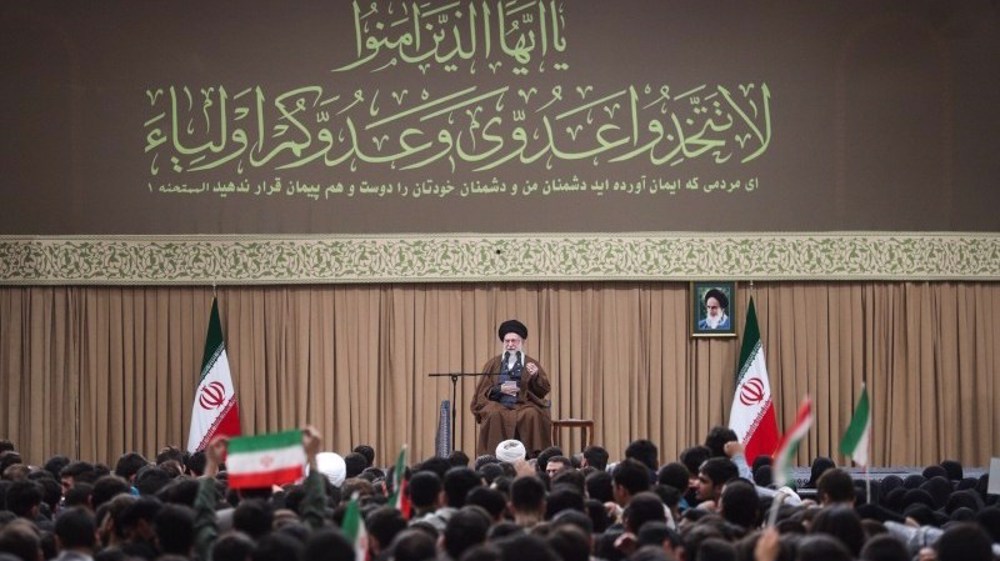
| Leader of the Islamic Revolution Ayatollah Seyyed Ali Khamenei addresses students and families of war martyrs to mark the anniversary of the 1979 seizure of the US Embassy in Tehran. |
Speaking on the eve of November 4, the “Student Day and National Day of Fight Against Global Arrogance,” Ayatollah Khamenei addressed thousands of students and families of war martyrs in Tehran to mark the anniversary of the 1979 seizure of the US Embassy in Tehran, describing it as a historically and identity defining event. Let us listen to his deep knowdlege, virtue and foresight, being the actual, in a certain way, representative, the pole or qtub, of the occult Imam, or the XII master-prophet of the Shia, the Madhi..

Ayatollah Khamenei outlined the history of US hostility toward the Iranian nation, saying the takeover of the embassy by students can be viewed from both a “historical” and an “identity” perspective.
From a historical standpoint, he said the takeover was “a day of pride and victory for the Iranian nation.” The Leader noted that Iran’s history includes both “days of triumph and days of weakness and decline,” all of which should remain part of the country’s national memory.
He emphasized the importance of preserving the embassy takeover in history and national memory, and of ensuring public awareness of it.
From an identity perspective, he added, “The seizure of the embassy clarified the true identity of the United States and also the true identity and essence of the Islamic Revolution.”
On the concept of arrogance, Ayatollah Khamenei cited the Qur’an. He said that sometimes individuals or governments consider themselves superior but do not interfere in others’ affairs, which does not provoke hostility.
“But sometimes, like the British government in a period and today the United States, they grant themselves the right to interfere in the vital interests of nations, set up military bases in countries whose governments are weak or whose people are unaware, or plunder the oil and resources of nations. This is the arrogance we oppose and against which we raise our slogans,” he said.
Ayatollah Khamenei traced the origins of US hostility toward Iran in modern history, noting the turbulence following the Constitutional Revolution.
He said that for about 40 years after that period, Iran experienced “either chaos and disorder, foreign interference, or brutal and harsh dictatorship of Reza Shah” until 1950, when the national government of Prime Minister Muhammad Mossadegh came to power.
He said: “The Americans smiled at Mossadegh but secretly, in coordination with the British, staged a coup and returned the exiled Shah to Iran.”
He described the August 19, 1953 as a “hard blow” to the Iranian nation and said it was followed by 25 years of severe dictatorship by Muhammad Reza Shah, with US backing.
The Leader also highlighted early American hostility toward the Islamic Republic after 1979, citing the “hostile resolution passed by the US Senate.”
Ayatollah Khamenei explained the public anger over the Shah’s entry into the United States, saying Iranians feared a repeat of the 1953 coup and a restoration of the Shah.
“The people of Iran felt that the Americans, by hosting Muhammad Reza, were seeking to repeat the August 19 coup and create the conditions for his return to Iran. Therefore, they angrily took to the streets, and part of these demonstrations, with the presence of students, led to the seizure of the US Embassy,” he said.
He emphasized that the students’ original plan was only temporary: “The initial intention of the students was a two- or three-day presence in the embassy to reflect the anger of the Iranian people to the world.”
However, documents discovered inside revealed that the embassy “was a center of conspiracy and plotting against the Revolution.”
He clarified that the embassy’s activities exceeded routine intelligence gathering: “It was forming a planning room to organize remnants of the previous regime, some army individuals and others for action against the Revolution,” prompting the students to maintain control.
Ayatollah Khamenei rejected the idea that the embassy seizure was the root cause of all US–Iran problems, pointing to the 1953 coup as the true beginning of American-Iranian conflict.
“The problem with the United States started on August 19, 1953, not November 4, 1979. In addition, the seizure revealed a conspiracy and a great danger to the Revolution that the students, by preserving the documents, were able to uncover,” he said.
He also stressed the consequences of American interference after the revolution. “The hostility of the United States against the Iranian nation in the years after the Revolution… is proof of the correctness of Imam Khomeini’s statement: ‘Whatever you can, shout at the United States.’
“Their enmity was not just verbal, and they used sanctions, conspiracies, support for Iraq, downing of an Iranian passenger plane with 300 aboard, propaganda wars, and direct military attacks because the nature of American arrogance is incompatible with the independence-seeking nature of the Islamic Revolution,” Ayatollah Khamenei said.
Addressing those who claim that the slogan “Death to America” provokes US hostility, Ayatollah Khamenei dismissed the interpretation.
“Those who claim that the slogan ‘Death to America’ is the reason for US hostility are misrepresenting history. This slogan is not the issue that the United States opposes the Iranian nation. The problem of the United States with the Islamic Republic is intrinsic and a clash of interests.”
On potential future relations with the United States, he said that America inherently seeks submission. “All presidents of the United States have wanted this, but did not say it openly. The current president spoke it aloud and revealed the true nature of the United States,” he said.
He emphasized that the solution to many national problems is strength, both military and scientific, administrative, and motivational, particularly among the youth.
“If the country becomes strong and the enemy feels that not only will it gain nothing from confronting this strong nation, but it will also suffer losses, the country will certainly achieve immunity,” Ayatollah Khamenei said.
He urged youth to study national history and political realities. “Youth should increase their knowledge and awareness of the fundamental issues of the country’s politics of yesterday, today, and tomorrow, by forming study groups and examining bitter and sweet events,” he said.
Scientific and military progress were central to his message. “Science must progress in the country… University officials, researchers, and students must not allow the pace of scientific advancement to decline,” he said.
“The military sector, by the grace of God, is working day and night and will go even further to show that the Iranian nation is strong and no power can subdue it or bring it to its knees.”
Ayatollah Khamenei also linked spiritual strength to national resilience, urging youth to follow the examples of Islamic figures Fatimah and Zainab. He stressed religious practices, including daily Qur’an recitation, prayer, and maintaining a connection to spirituality as essential for resisting global powers.
 |
| Hazrat Fatimah |
He concluded with a message to the youth on personal and collective strength: internal knowledge, faith, and spiritual awareness are critical to the survival and advancement of the country.
By achieving strength in these areas, Iran can maintain its independence and resist external pressures without compromise.»


Sem comentários:
Enviar um comentário