sexta-feira, 17 de julho de 2026

Guénon, Evola, and Tantra with Nietzsche, an excerpt from "Julius Evola: An Adventurous Life" by Andrea Scarabelli published by Prav and Arktos.


Received from PRAV Perspectives <pravpublishing@substack.com>

This chapter shared by PRAV Perspectives is very valuable for the understanding of two of the most important esoteric masters of the XX century, who have developped their own philosophical and metaphysical theories of the path of Mankind towards truth, with concordand and discordant positions, very well exposed in this text.

We know how René Guénon (1886-1951)  was more a metaphysician of the suprarational intelect, of the Absolute, of the supreme Unity, in the path of Knowdlege trodden and expounded by the Indian Jnanis, of the Vedanta darshana (specially the advaitic or non-dual), being introduced to it shortly after his passage by the hermetica, gnostica, maçonic and catholic traditions and initiations, path of Knowdlege that he found also in Islam, being since 1911 acquainted with sufism, and becming Islamic and living his last 25 years in Egypt, writing his books.

Julius Evola, being twelve years younger (1899-1974), had a very different journey, much more active, bold and revolutionary (even if in part in the fascist Italy), being a Kshatryia, a warrior, compared to René Guénon that was much more a Brahman, an intelectual and contemplative, and I am using the terminology of the castes of Indian tradition so much studied and appreciated by the two, who have become the most known and influent theoricians and representatives of the Perennial Tradition, or Primordial Tradition.

Surely both had their limitations, some errors are patent in their works, still much can be better understood of modern society and of spiritual paths for our days by reading and meditating them.


Andrea Scarabeli makes a vivd reconstituition of their relations, their frictions and criticisms, but introduces us also to others, like Guido De Giorgio, an important Traditionalist that was trodding the Catholic path of devotion, that Guénon underestimated, as for him mysticism had very little to do with initiation and metaphysics, and who was the confidente receiver of the letters writen by Guénon questionning  positions and writings of Evola. By his side, Evola liked Giorgio and after his death he published some of his letters. Also remarkable is the good relation and colaboration established between the pionneer of western studies on Tantra, the judge and sir John Woodrofe and the young warrior and "tantrik" Julius Evola...

Julius Evola and Maria de Naglowska
    «The year 1926 is also the year of the great public confrontation between Evola and Guénon. It was a conflict between two men, two generations, two ways of understanding ‘tradition’ (which at that time was still written in lowercase), which had matured in silence since 1925, as can be seen from the correspondence between the French metaphysician and Guido De Giorgio, the Catholic Traditionalist who, for better or worse, acted as a mediator between these two men, separated by twelve years and by two worldviews that could not be reduced to a common denominator: Guénon often ‘used’ De Giorgio to ‘discipline’ the philosopher, who was categorical in his judgements and equally hasty in his conclusions. Evola’s name appears repeatedly in their correspondence: in practically every letter, Guénon expresses constant, often ruthless judgements about him. ‘I wonder if it will ever be possible to do something good with Evola,’ he wrote to De Giorgio on 7 March 1930 — an attitude, as has been noted, reminiscent of that of a teacher towards a disobedient pupil who must be brought to heel.
De Giorgio himself was often quite ‘testy’ [impatient, irritable] with the philosopher, towards whom he harboured a certain suspicion, especially with regard to the idea of going beyond the devotional-religious level, which in his eyes was a tad sacrilegious. This persistent suspicion would confirm and radicalise that of the French metaphysician (as can be seen from the latter’s replies), creating a mechanism that would become increasingly ruthless as the years went by. ‘What is really strange is the way in which you are treating Evola and the result you are achieving’, Guénon wrote to him on 15 January 1930: ‘I doubt very much that he would accept it from anyone other than you.’
Evola was completely unaware of these manoeuvres and never hid his admiration for the author of La tradizione romana (“The Roman Tradition”), drawing a famous portrait of him in The Path of Cinnabar:
‘He was a sort of initiate at a wild, chaotic level. He […] was exceptionally learned and knew many languages. His character, however, was rather unstable — or subject to manic-depressive episodes, as a psychologist might say — and pervaded by passionate, emotive and lyrical drives reminiscent of Nietzsche’s temperament.’
He was so disgusted with the modern world that he retreated to the mountains of Piedmont — Evola met him there a few times — and ended up in a dilapidated parish house near Mondovì, where he lived a modest and frugal life. His only published book appeared posthumously (we shall return to this), but he sent Evola several heated and inspired letters, which Evola transcribed and published in Ur, La Torre, and Diorama Filosofico. De Giorgio ‘dramatised and energised the idea of Tradition, which Guénon, in conformity to his own personal equation, presented in exceedingly formal and intellectual terms. To this, De Giorgio added a personal tendency towards absolutist positions which proved most congenial to my own character.’
De Giorgio was the (not too impartial) ‘arbiter’ of the dispute between Evola and Guénon, whose name had been circulating in Italy for some years, thanks to Reghini’s tireless work in Ignis and Atanòr. It was precisely the Pythagorean who put him in contact with Evola, who showered him with articles, often critical, which the Frenchman did not take very well.
On 26 January, Guénon wrote to De Giorgio that he had read Il problema di Oriente e Occidente e la teoria della conoscenza: i Tantra (The Problem of East and West and the Theory of Knowledge: The Tantras). In this essay, published in three parts in Ultra between February and September 1925 (it was to form the first chapter of L’uomo come potenza [Man as Power]), Evola called Guénon a ‘rationalist’ for advocating the primacy of ‘pure intellectuality’ (a phrase with a very different meaning) at the expense of ‘power’: ‘Evola does not lack pretensions, as you see; but, for my part, I insist on thinking that he does not understand at all what we mean by ‘intellectuality’, ‘knowledge’, ‘contemplation’, etc., and that he does not even know how to distinguish between an ‘initiatory’ and a ‘profane’ point of view.’ Guénon rolled with the punches for the time being, adding: ‘It seems that he intends to have an account of my work on Vedanta published in the journal L’Idealismo Realistico; we’ll see what comes of it.’
More than a simple compte rendu, the text that sparked the polemic was a long essay on Man and his Becoming According to the Vedānta published in the aforementioned journal in the autumn of 1924.
                                                 
Once again, Evola interpreted the primacy of ‘contemplation’ advocated by Guénon as ‘rationalism’, opposing it to the ‘magical’ and ‘Hermetic’ realisation that characterised the Western tradition, consisting of ‘free initiative, affirmation, the value of individuality, a tragic conception of life, a will to power and action.’ These ‘magical’ elements, resting on the Nietzschean background that characterises the ‘first Evola’, were in fact also present in certain Oriental traditions, which Guénon, however, deemed to be ‘deviations’, as he suffered from a ‘dogmatic and authoritarian tendency.’ Following in Reghini’s footsteps, the Italian philosopher contrasted the strength of a Western tradition to those who lost themselves in ‘Oriental mists.’
‘We affirm that if the East represents a spiritual reality, so does the West,’ he wrote, referring to Essays on Magical Idealism and Man as Power, ‘soon to be published.’
To simplify, on the one hand we have Guénon, the East, and metaphysics; on the other Evola, the West, and magic. Here is the extent of the unbridgeable gulf between the two: while the Frenchman preferred contemplation and was rather allergic to magic (although he was aware of the particular meaning that his Italian correspondents attached to the term), Evola sided with action. And — at least in the Evolian vision of those years — the former stood for ‘metaphysics’ just as the latter stood for ‘magic’, which is to say Roger Bacon’s ‘practical metaphysics’, based not on faith but on self-realisation [this quotation should have been more substantiated by Scarabelli]. While Guénon was a metaphysician, with a meticulous mathematical rigour and a Cartesian style (Antoine Faivre called him the ‘Descartes of esotericism’), Evola was a magician who employed an evocative language. We only have to read a few pages of Ur on the subject to realise this:
«Magic cleanses the world, restores it to its free, supersaturated, essential state; to that state in which nature is not yet nature nor spirit, in which there are no ‘things’ and no ‘gods’, but powers; in which life is a heroic affair of every moment, made up of acts, symbols, commands, magical and ritual gestures, in great waves of ‘sound’, light, and terror.»
Magic, we read in these pages, creates: not bridges, but distances, chasms, between beings. Neither ‘brothers’ nor ‘fathers’, but stronger forces and weaker forces, side by side or against each other, loyally, coldly acknowledged, in the discipline of a spirit inwardly inflamed, but outwardly rigid and hardened like steel, containing in magnificent measure the boundlessness of the infinite: militarily, as in a war enterprise, as on a battlefield.
It does not produce ascetics or mystics, but ‘solar and self-sufficient beings, a breed of far-sighted, fearful, and distant Lords who ‘are of themselves’, who do not take but give a superabundance of light and power, and resolutely turn towards an ever more dizzying intensity.’
Frontispiece of the magazine Ur dating from 1928, prior to the split in the editorial committee (Calcara Collection).

These were rather ‘Luciferian’ words in the eyes of the more measured Guénon, who would never write for Ur, while De Giorgio, who was equally opposed to these theses, would publish scathing lines against the ‘magical divulgation’ of the Group (which he never joined and towards which he harboured quite a few suspicions). In the essay La magia, il maestro e il canto (“Magic, the Master, and Song”), he noted:
‘He who really practises magic: 1) is completely unknown, for he makes sure to hide himself, or rather must hide himself (absolutely); 2) discourages others from practising it (absolutely); if he limits himself to this (very rare), he closes himself off, and must close himself off, in an icy shell; 4) uses it for ‘another purpose’, and that is that.’
De Giorgio too preferred the ‘traditional’ option to the ‘magical’ one, and he wrote as much to the philosopher — who published De Giorgio’s letter, with the comment:
‘Finding that the modern world has essentially developed on the trunk of action, we believe that the most appropriate formulation of ‘Tradition’ today is the magical one.’
This option, according to Evola, was the only one capable of resolving the crisis of the West without contradicting its intrinsically active nature.
Let us return to the casus belli. The Evolian essay [by Evola] saw in the Vedanta described by Guénon a ‘nihilism of reality, values, and the individual.’ Evola also sought to go beyond rational consciousness, but in a completely different direction:
‘What lies beyond concepts is power. Beyond the philosopher and the scientist there lies not the saint, the artist, or the contemplator — but the magician: the dominator, the Lord.’
This was too much. In May 1926, Guénon launched a counterattack, again in L’Idealismo Realistico [revue of Gian Franco Lani and Evvola, 1924-1931]. In the essay A proposito della metafisica indiana: una rettifica necessaria (“On Indian Metaphysics: A Necessary Rectification”), he turned the accusation of ‘rationalism’ back on Evola, seeing it as linked to a fundamental misunderstanding of ‘metaphysics’ and ‘pure intellectuality.’ He ascribed to Evola a ‘voluntarism’ closer to the likes of Nietzsche and Schopenhauer than to Tantrism, one which ‘certainly has nothing metaphysical or, in any case, initiatory about it.’ It was just one of many examples of the ‘manifest incomprehension’ of the Italian thinker, who, ‘in spite of his intention to speak of our book, has only read it very distractedly!’ Guénon’s tone was condescending but not unjustified, given that Evola had advised him to think longer before publishing such texts! But it had taken Guénon fifteen years to write the book, whereas his accuser ‘is very young, and that is undoubtedly what excuses him; he still has much to learn, but he has time ahead of him and may be able to learn it… as long as he changes his attitude a little and doesn’t pretend to know everything already!’
It was quite a scolding to which the smug [in what exact sense?] Evola replied in a note that followed Guénon’s ‘rectification.’ He responded to many of the points raised by Guénon — not all of them — and underlined how the Frenchman, in turn, had failed to grasp all the objections raised. In this respect, it was quite a typical controversy… Evola defended the Tantric option, stating that he had received ‘sufficient assurances from people who have had direct and inner relations with it.’ He referred to John Woodroffe, about whom we will speak shortly. He concluded: ‘Of course, we have many things to learn still — but we also have some to teach. […] To those who begrudge us our age […] we might reply that they must envy us for having the time to learn which others, who need it at least as much, lack in their advanced years.’ He concluded by mocking the Frenchman who ‘feels the need to speak ex tripode, from the height of an intolerant and dogmatic authoritarianism — in truth, more like a Protestant pastor than a serious scholar of initiatory matters.’
This exchange reveals a difference in ‘personal equations’ that was destined to endure even after the philosopher embraced the ‘traditional’ perspective — which is why it is inaccurate to define Evola as a ‘pupil of Guénon.’ But there is also some common ground, as has been shown by all those scholars who have explored both authors sine ira et studio, freeing themselves from their respective ‘scholasticism’ and orthodoxy. This common ground was glimpsed by Pierre Pascal, who recalled — with much emphasis and a little ‘embellishing’ — an evening he spent in the company of the French metaphysician in 1928. When Guénon opened the door for him, Pascal saw that he was holding [strange...] Man as Power, Theory of the Absolute Individual, and Pagan Imperialism.
‘Here are three Italian books of the utmost importance’, Guénon reportedly said. ‘They speak as we speak, which may seem incredible. But it is so! They are steep books that do not spare the reader, for their style is one of icy fire. The author, known to our best brethren in Heliopolis [?], is called Julius Evola.’
‘What a fine name and what a fine surname!’, replied Pascal. ‘It seems to rhyme with Dante’s verse… ‘Who soars above others like an eagle.’’
‘As always, well said, dear Pascal! Indeed, fire in ice and ice in fire… The tone of an eagle... the demon of action!’
Pascal read all three and was thunderstruck. He concluded: Evola and Guénon were awaiting ‘a high noon of bodily and spiritual liberation.’ Beyond their differences, the two were part of ‘a conspiracy of souls’, ‘a kind of armed vigil, a chivalrous ritual, a nocturnal stand against the Prince of this world, against the potestas tenebrarum.’
This is a wonderful testimony — perhaps too wonderful to be true — which, apart from its exaggerations, captures [or mystifies...] a shared horizon and proves that this polemical exchange did not exhaust their personal and intellectual relationship.
That year Evola made a comeback as an author with two works. One was a pamphlet entitled L’individuo e il divenire del mondo (The Individual and the Becoming of the World), which brought together two lectures delivered in Via Gregoriana in December 1925. The first, which gave the booklet its title, was published in Ultra in December of that year and then translated into German in the journal Logos. In The Path of Cinnabar, Evola anticipates the publication of the German version with respect to the forthcoming Italian version, for in reality it was published in 1931 under the title Die drei Epochen der Gewissheitsproblems, thanks to the interest of Guido Calogero. 
It was Gentile’s pupil, the editor of the Italien Heft devoted to Italian idealism, who chose the text — to the consternation of the review’s editorial board, given Evola’s outsider status in university circles. The theorist of the Absolute Individual sent him the essay on 4 August 1930: ‘Here, then, is the article for Logos. I hope it will go. It was translated by a German, and then revised by another German, a graduate in philology.’ Although he had passed through what is conventionally defined as the ‘philosophical phase’, the end of which is just as conventionally set at 1925–26, Evola actually continued to engage with philosophy in the following years — and not only through essays and articles.
From 26 to 29 May 1929, the annual National Congress of Philosophy was held in Rome. While the honorary committee was chaired by His Excellency Benito Mussolini, the organising committee was headed by Gentile. Although Evola was not among the speakers — he was not an academic — on the afternoon of the 28th he took part in the discussion sparked by the neo-Thomist Gustavo Bontadini’s paper Critique of the Antinomy of Transcendence and Immanence. The panel was chaired by Calogero himself, who in the following days asked Evola for a summary of his speech. On 26 June, Evola sent him ‘the summary of my address. You can, of course, make any changes you think fit.’ The text was eventually published in the proceedings, together with another one, in the margin of Giuseppe Saitta’s paper, The Subjectivist Aspects of Plotinus’ Epistemological Doctrines, a long-standing interest of Evola’s. The collaboration with Calogero would continue the following year, when the professor delivered the lecture Idealism as Solution and Idealism as a Problem to the Association for Moral and Religious Progress on 11 May 1930. Evola and Ugo Spirito also took part in the debate, at the request of the speaker.
As for the second part of Evola’s pamphlet, it is the transcription of the lecture given on 6 December 1925 at Via Gregoriana, entitled Nietzsche e la sapienza dei misteri (“Nietzsche and the Wisdom of the Mysteries”), an elaboration of the article Dionysus he had published in Ignis in November–December 1925. This text would follow Evola until the end of his days: he would reread and revise it, softening the original Nietzschean and anti-Christian tones, and making continuous changes that testify to an intellectual journey not without setbacks and second thoughts.
A record of Evola’s first ‘public appearance’ in Via Gregoriana is found in the following words from The Path of Cinnabar:
‘I had composed this essay in a state of lucid intellectual vertigo’ and ‘the work certainly contained a certain ‘drive’: for when I once read the essay at a conference and attempted to stir those feelings which I had personally felt when writing the text, there were people among the audience who even experienced visions and hallucinations.’
                                            Painting by Julius Evola, untitled, 1919.
The second book of 1926 was more organic: an impressive work on Tantrism, which had been in progress for some time, entitled L’uomo come potenza (Man as Power). The Tantric teachings were bound to attract Evola’s interest, both because they were based on the concepts of freedom and power, and because in discussing them theoretically, Evola was presenting the fruits of his own research — including, but not limited to, philosophical research. Unlike the few other studies of Tantrism available in Italy, Evola’s reflected a certain kind of interest that was not merely speculative, but rather focused directly on the ‘operative’ core of the teachings in question.
The writing of this book is inextricably linked with the English judge John Woodroffe, who was born in Calcutta and initiated into Tantrism. Evola probably first heard of him from Decio Calvari or perhaps from [Giusepi]Tucci and Formichi. In the second half of the 1910s, Woodroffe published several books on the subject, introducing it into academic circles and dispelling many of the commonplace misconceptions prevalent among English-speaking scholars. One famous study stands out, The Serpent Power, published in 1918 under a pseudonym with strong Hermetic overtones: Arthur Avalon.
Evola had a long correspondence with Woodroffe, which is unfortunately lost; he sent him some of his writings, most likely the issues of Ultra with essays on the Tantras. In 1926, Woodroffe, in agreement with Evola and Calvari, submitted to the journal a text entitled Sâdhâna, which was presented with great pomp together with Hanumanthia Rao’s essay Contacts between European and Indian Philosophy. The Roman philosopher was fascinated by the subject from the moment he discovered it and tried to spread it through all the channels at his disposal. In October 1924, Bilychnis [revue, 1912-1931] published his essay Il mondo come potenza (“The World as Power”), a quotation from Woodroffe’s volume of the same name (which Evola was to have published by Mediterranee in the late 1960s). In the same year, he gave the above mentioned lecture on the Tantras to the Theosophical League, the text of which was published in Ultra and, in three parts, in Atanòr (as already mentioned, Evola would review Avalon’s The Garland of Letters for Ignis in 1925, while also discussing yoga and Tantrism in Bilychnis). Meanwhile, he devoured all the volumes in the prestigious Tantrik Texts series, which collected teachings that had only been transmitted orally or in manuscript form and were therefore inaccessible to ‘laymen.’
Arthur Avalon was very impressed by the young man’s preparation. He went so far as to quote him in the preface to the third edition of Shakti and Shakta, simply translating into English the sentences of one of his letters. Evola was trying to do in Italy what Avalon had done in the Anglosphere — and he was doing it with the help of Alvi, who had offered him the support of the Atanòr publishing house. But what also struck the English judge was Evola’s theoretical horizon: his attempt to overcome the dialectical opposition between East and West at a time caught between superficial and exotic ‘Orientalisms’ and bigoted ‘defences of the Christian West.’ [Guénon was also on that endeavour.]
In the first chapter of his book, Evola discusses The Spirit of the Tantras in Relation to East and West (through the paradigmatic figures of Hegel, Steiner, and Keyserling). He sees East and West as two poles of a metaphysical rather than a geographical nature, and breaks down their supposed antithesis into that between ‘tradition’ and ‘modernity.’ He does this by using as a ‘universal key’ a canon that blends thought and action on the basis of power, a term that unites men and gods, essence and appearance (māyā). In Evola’s analysis, there is no qualitative difference between the planes of reality, but only a quantitative one, linked to the power of each phenomenon and the degree of awareness that accompanies its exercise. This power, which means awakening and realisation, is based on the will and produces, as he himself wrote, ‘a doctrine of the Übermensch which would put Nietzsche to shame.’
In the eyes of many — including Guénon — this option was still too Western and philosophical. Evola’s ‘Nietzschean Tantra’ sparked a polemic with Prof. Vittorino Vezzani, who the following year deplored the anti-Christian overtones of the volume in Ultra. Evola responded in the same journal in March–June 1927, proclaiming the absolute independence of occultism from all morality, philosophy, religion, and value systems. He described it as a discipline of self-realisation beyond good and evil:
‘The path of the ‘Dominators’ and ‘Mages’ requires more desperation, more power of renunciation, sacrifice, and overcoming, more heroism, […] without the support of any prospect of reward, happiness, consolation, and love, than your so-called ‘mystics’ and ‘saints’ could ever teach us.’
This was the very crux of the matter, as Evola did not fail to emphasise:
The fact is that Vezzani is Christian to some extent — and we are not: this is the real difference. Christian values are democratic, sentimental, egalitarian, humanitarian, eudaemonistic (happiness, harmony) and based on insufficiency (the need for love, grace, salvation) [critics made by Fernando Pessoa also, and mostly, as Guénon has done, about Theosophical society]. Our values, on the other hand, are aristocratic, heroic, anti-eudaemonistic values based on difference, will, and hierarchy.
Evola then ended his reply by attacking Theosophy for its ‘exotic’, ‘moralising’, and ‘clairvoyant’ features. Reghini’s influence is evident in these words, which would lead to yet another repartee between Evola and Vezzani in the columns of Luce e Ombra. This journal witnessed a further clash in 1927, this time between Emilio Servadio, a defender of Evola’s theses, and the editorial staff — a controversy into which Evola himself would enter in 1928 with the essay Idealismo e metapsichica (Idealism and Metapsychics) published in Ur. The polemic continued until his personal encounter with Servadio, which we will discuss.
To return to the book L’uomo come potenza, it received plenty of positive reviews, such as the one that appeared in Logos (January–June 1927), which described the text as ‘one of the most serious and complete studies of the metaphysical and magical wisdom of India.’ In a way, this statement captures the real point: we must not forget that the ‘Tantric option’ responded to a precise cyclical logic that was creeping into Evola’s work in those years, inspired by Guénon, but which would bear fruit at the beginning of the 1930s (although, as already mentioned, this fruit would not be too pleasing to the French metaphysician). In a dark age like ours, writes Evola, the methods of liberation valid in other epochs are no longer effective, while those considered ‘exceptional’ acquire an irrevocable centrality: in the Kālī-Yuga,
‘It is elementary forces which now prevail: man finds himself connected to such forces and unable to retreat; hence, man must face these forces, control them and transform them, if he wishes to find liberation and freedom. The path to this goal can no longer be the purely intellectual path, nor the ascetic-contemplative path, nor the ritual one. Pure knowledge in our day must lead to action.’
These few lines encapsulate Julius Evola’s ‘personal equation’, so much so that, in the second part of the volume, the philosopher leaves the ‘speculative’ plane and offers the reader some practical-operational indications that he personally followed in recent years — perhaps also to escape the powerful crisis that almost killed him — and which he would later follow in the context of the Ur Group. They are aimed at training the Will, freeing it from craving and base impulses, as well as from the external objects to which it is often attached. It is not difficult to detect autobiographical overtones in precepts such as:
‘Every negative state (pain, dejection, exhaustion, imbalance, etc.) contains a possibility — a kind of opening — for a higher, superhuman affirmation. The whole secret is to remain vigilant, and when the wave comes, to leave oneself, to take off, to identify not with the surpassed but with the surpassing.’
In addition to evoking images, but also of states of mind, which can voluntarily be dispelled if necessary, Evola invites us to break all established habits that drown the will in automatism. We have to train our memory — as soon as we wake up, we have to envisage our whole day, doing exactly what we have set out to do; and in the evening, before going to bed, we have to check how closely what we planned matches what we have achieved [a teaching from the Pythagorean Tradition, well studied by his friend Reghini]. Like the practices collected by [the brothers futurists Arnaldo] Ginna and Corra, Evola’s exercises also use certain phrases and expressions for the purpose of ‘self-suggestion.’ For example, before going to bed, the practitioner — i.e., Evola — says: ‘I have of a will’, adding, increasingly softly, words such as: ‘firm calm resolute’, and ‘full energetic self-master self-sufficient.’ He then immediately falls into a deep sleep, but only after saying the words: ‘I am — power.’ The practitioner must establish absolute mastery over himself: ‘If there are attacks, do not resist, give in without fighting [strange methodologic quietism], let them tire […] and then reassert yourself.’ The general condition for carrying out these exercises is a ‘sober life, without excesses, vegetarian food (the reason: animal food, compared to vegetable food, is already organised with respect to the human being; thus, by eating it, certain subtle forces remain inactive and create a latent torpor, a burden in the occult discipline).’ One must get up at dawn and not stay up too late, ‘see as few people as possible, especially blood relatives and people who are sentimentally attached to you’ (rules which the author did not follow too strictly).
Since we cannot quote the entire practical section, we will limit ourselves to pointing out another exercise that prepares one for yogic realisation. Similar to the Midnight Sun, it consists of two phases and is based on the transformation of the inhaled breath into light. In the evening, before going to bed, ‘be silent. Visualise a sun gradually rising until it reaches midday. Hold it like this for a few moments in the fire of consciousness.’ Then spell out the words ‘I am light’, and after mentally removing them, quickly fall asleep. The next morning, as soon as you wake up, maintain the same state of silence: ‘take the sun from midday and let it gradually set until it is twilight.’ Then get up, do some exercise, and get dressed, but only after saying:
‘The light is within me.’
These exercises actually have little to do with yoga: they are definitely based on Western sources. Their daily practice is what saved Julius Evola…[? Andrea Scarabelli should explain more this salvific statement, or describe the sources, specially because probably the Evola of mature age was not needing to do these exercices,  created by him with bases of the Indian mantra tradition and surely, as it is sugested, by the brothers Arnaldo Gina and Bruno Cora.]
So, surely a very good book to buy and read... And may the best teachings and influences from Evola, Guénon and the others brethrens of the Light of the Divine Sun inspire us...


quinta-feira, 16 de julho de 2026

Evangelho de Tomé, escrito entre os anos de 40-50. Um dos 114 ditos de Jesus pouco conhecidos, gnósticos, valiosos.

Do Mosteiro do Salvador do deserto encarpado, em Klykovo, Kaluga
Entre os cinquenta e um códices ou livros encontrados em 1946 no Alto Egipto, em Nag-Hamadi, nas imediações do mosteiro copta de S. Pacómio, em Chenobokya, o mais importante é sem dúvida uma das primeiras recolhas, provavelmente dos anos 40-50 d. C.,  de ditos de Jesus, intitulada Evangelho de Tomé.  Os sábios e clarividentes monges, enterrando-os dentro de ânforas seladas nas areias, quiseram provavelmente fazer escapar tais obras considerada não ortodoxas ou canónicas  mas que contém ensinamentos muito valiosos. Se a maioria dos 114 ditos ou logions  foi incluída nos Evangelhos sinópticos, embora com diferenças e por vezes significativas, outros só os conhecemos por este evangelho de Tomé, ou então por fragmentos gregos e citações dos primeiros padres da Igreja.
Como ao longo dos anos os tenha trabalhado, resolvi partilhar alguns, para relembrar a sua existência e as suas palavras.
Um dos desafiantes ditos ou logions é este:

21. «Maria Madelena perguntou a Jesus: Com quem se parecem os teus discípulos? Ele respondeu-lhe: Parecem-se com jovens crianças instaladas num campo que não é delas. Quando vierem os donos do campo dizem-lhes: deixai-nos o nosso campo. Eles despem-se diante deles de modo que o deixam e o dão a eles.
Por causa disto eu digo isto: se ele sabe, o mestre da casa, que o ladrão vem, vigiará antes que venha e não o deixara penetrar no interior da casa do seu reino, de modo a que ele tome conta dos seus bens.
Vós, pelo contrário, vigiai em face do mundo, ligai-vos sobre os vossos rins por uma grande potência de modo a que os salteadores não descubram o caminho para chegarem até vós, pois o lucro, colheita que esperais, eles o descobrirão. Que esteja no vosso centro um homem experiente, que quando o fruto está maduro, vai à pressa, a sua fouce na mão e colhe-o. Quem tiver ouvidos, para ouvir, que entenda.»

Um dito que mostra como a intensidade da invocação da realização espiritual deve ser grande nos que aspiram à luz, nos gnósticos, nos discípulos. O engendramento da Divindade, da consciência do reino do Pai ou espirito em nós, é exigente. Como estarmos abertos e sentindo a subtil realização espiritual senão pela aspiração, alinhamento e discriminação constantes, para que haja a identificação com o Espírito e a sua unidade com o mundo Divino?
De que identificações e posses, apegos e preconceitos, devemos despir-nos, desprender-nos?
O dono do mundo que surge a pedir tal é a hora da morte, a morte?
O que é que esperamos de colheita e que pode ser roubado? Será a consciência de pertencermos, de estarmos no reino ou mundo espiritual, que foi mais ou menos alcançada em vida?
Quem são os ladrões, perante quem devemos estar vigilantes? Serão as muitas distracções de pensamentos e de desejos, exteriorizações frequentemente desnecessárias, e que nos desalinham da auto-consciência espiritual, tal como os medos, as dores, os sofrimentos, que nos tornam mais pesados, menos susceptíveis de nos elevar à consciencialização e contemplação do espírito? 
É a ligação interior e contemplação que permite a acção justa de cavalgarmos o dragão, de usarmos a foice que colhe na altura certa o que é necessário ou conveniente?
É interessante observarmos o movimento antitético: ora nos despimos e entregamos o campo, ora nos vestimos, cingimos os rins e resistimos. É o movimento pendular, da exteriorização e da interiorização, do repouso e do movimento, da entrega e da luta, para descobrirmos o animus central em nós, que sabe estar no meio, tender ao centro e  recolher o fruto, a consciência firme, espiritual e divina.
 O grande ladrão que nos rouba e assalta é tanto o mundo como também o ego, sempre pronto a reagir instintivamente ou desferir os seus golpes e por isso  não nos deixemos levar pelas suas ameaças, medos, receios ou ofertas tentadoras e antes saibamos concentrar-nos no verdadeiro lucro, a pérola preciosa, que está no nosso interior, no centro do nosso ser.
Estarmos firme em nós próprios, conscientes das nossas forças e limites e ligações, sem nos deixarmos trespassar por doenças, roubos ou seduções. Estarmos e respirarmos conscientes, o nosso eixo vertical espiritual fazendo a cruz ígnea com o horizontal e discernindo que é o certo a cada momento da nossa participação e passagem actuante no mundo terreno e psíquico, irradiando a verdade.
Quando chegar a hora da morte, e esse é um dos sentidos de ela ser representada como a segadora, ou o Saturno do tempo que tudo leva, há que estar pronto. Demos o melhor a cada momento, para chegarmos à hora final e não partirmos frustrado e ficarmos agarrado à Terra e aos mundos intermediários
Esta hora da morte pode ser também a iniciática quando devemos morrer para o nosso ego e actividades psíquicas e aspiramos e estabilizamos na consciência da unidade no mundo espiritual.
Colhe ou comunga mais a realização espiritual sempre que sintas a tua disponibilidade para a sua proximidade de ti. Comunga com regularidade com o Espírito, sê mais auto-consciente do Espírito imanente, ligado ou parte do transcendente da Divindade.
Eis, brotando do nosso limitado quartzo, umas pequenas centelhas  do profundo e elevado fogo espiritual contido ou invocado no Evangelho de S. Tomé.

quarta-feira, 15 de julho de 2026

Diary of the War. Beginning on 15/7. Títulos de notícias da Tass. com, russa para contrabalançar a manipulação nacional. Começado a 15/7, quando a III grande guerra se torna mais evidente.


Na madrugada do 15 de Julho, por volta das 4 horas, tendo meditado bem na consciência espiritual e no silêncio cerca de 45 minutos,  deitei-me e mais descontraído vi no olho espiritual, por duas vezes, uma sucessão de imagens ao longe, num horizonte de casas e, telhados, de formas quadradas ou rectangulares, e sobre elas, explosões de luz, sem som, alaranjadas e brancas e com algumas formas estilo sombras humanas evolando-se esguiamente para o céu. Senti como se fosse guerra e as sombras, pessoas que morriam. Não houve emoções, apenas observar e admitir que poderia significar isso.

Como já há algum tempo que se torna evidente que estamos nos preliminares da III grande guerra travado pelo ocidente hegemónico, neo-liberal, globalista, sionizado, nazificado, obediente as directrizes da oligarquia sionista e imperialista, principalmente Israel e EUA, e que os actuais dirigentes da União Europeia são os principais líderes da confrontação com os países e povos da multipolaridade e da resistência ao materialismo capitalista infrumano, que não transhumano, em especial neste momento a Rússia e o Irão, e que a maioria dos meios de comunicação mais importantes estão controlados por eles, resolvi começar um diário do confronto a partir dos títulos de notícias da Tass. com, da Rússia,  para contrabalançar a alienação e estupidificação nacional. E começamos com algumas significativas de hoje, e que servirão para constatarmos como os governantes norte-americanos são os mais mentirosos e insensiveis, gananciosos e criminosos do mundo, com os da União Europeia a desejar sê-lo também. 12 títulos, para compreendermos melhor o mundo:

Dia 15:
West to justify killing of Zaporozhye nuclear power plant chief engineer — Duma deputy
EU defense spending nearing pre-World War II levels, Russian diplomat says
Trump says sets no deadline for expanding strikes on Iran
US not to conduct ground operation to change Iran’s government — Vance
Serbia to stay out of military anti-Russian coalition being created by EU — Vulin
Ukraine to receive 300 mln euros in EU grants to finance defense
Russia says France's refusal to grant visa to TASS reporter for UNESCO events puzzling
EU defense spending nearing pre-World War II levels, Russian diplomat says
Trump suggests findings of investigation into strike on school in Iran may never see light
Zelensky pledge to step up mobilization in exchange for EU loan genocidal — MFA
Those plotting 'new campaign' against Russia should remember lessons of history — MFA
European Commission strips Venice Biennale of grant over reopening Russian pavilion
(Se quiser traduzir, copy paste no excelente Quillbot)
Dia 16:
US strikes Bandar Khomeini, destroying a bridge — Fars
EU distributes military orders to Ukraine to attack Russia — Russian Foreign Ministry
Biden's corruption one of foundations of conflict in Ukraine — Russian envoy
Israeli Air Force attacks Hezbollah strongholds in southern Lebanon
FACTBOX: What we know about removal of Max and VK apps from Google Play
European leaders hold their peoples hostage to military-terrorist bloc — Russian SC

17 July
Five bridges targeted by US strikes in Iran’s Bandar-e Imam Khomeyni — Fars
President says Brazil will not succumb to US pressure
Kiev sees second consecutive day of protests over defense minister's dismissal
Xi Jinping calls for AI development to respect global civilizational diversity
Ukrainian authorities brainwash children to hate Russia — human rights commissioner
Russians’ trust in Putin approaches 71% — poll 
Military in Africa trying to open second front against Russia — senior diplomat
US strikes Iran for seventh consecutive night — CENTCOM
Russian diplomat says France’s accusations of cyberattacks are unsubstantiateI
Iranian military adviser issues stark warning to US if it keeps attacking Tehran

terça-feira, 14 de julho de 2026

Ayatollah Seyyed Ali Khamenei, by Graig Murray, author and ex-british embassador. Extracted from an article of Alireza Kamandi, on Press.tv.ir


An important contribution to the correct understanding of the soul and role of Ali Khamenei in our days, specially in defense of Iran nation from the treacherous israelo-americans agressores, done in an interview by Graig Murray, and writen in this article on Press.tv. ir , by Alireza Kamandi. Graig Murry enhance thhe fiery legacy of resistance against the imperialism and zionism passed by Ali Khamenei not only for Irianians, now stilll more united in defense of their state-cilization and shiia religion, but for all the world where there is people with consciouness and of good principles, so nurtured by the marthirised leader and imam.

«Ayatollah Seyyed Ali Khamenei was a rare leader and statesman whose unwavering moral compass, rejecting nuclear weapons even in the face of existential threats while remaining steadfast in resistance to US-Israeli hegemony, made Iran a global symbol of principled leadership, says an analyst.

«In an interview with the Press TV website, Craig Murray, a former British ambassador and author, paid tribute to the martyred Iranian leader for his distinguishing traits.

He highlighted Ayatollah Khamenei’s unwavering commitment to moral and religious principles, particularly in the face of extreme external pressure, including sanctions and imposed wars.

Murray noted that despite Iran being threatened by the United States and Israel, both nuclear powers, the nation stopped short of developing a nuclear weapon, though it easily could have.

This restraint, he noted, stemmed from the Iranian leader’s conviction that such a course would be morally wrong, calling it a tremendous tribute to his character.

Murray also contrasted Iran’s conduct in war with that of its enemies, pointing out that Iran has not targeted schools, hospitals, or journalists – unlike the US and the Israeli regime – and attributed this restraint to the Ayatollah Khamenei’s firm moral teaching.

On the global resonance of the martyred Iranian leader’s stance, Murray said that Iran has become incredibly important to people worldwide as the effective center of resistance against the resurgence of US imperialism and its operation through the colonial settler entity of Israel.

This includes opposition to Israel's expansion and the genocide against Palestinians. The former British ambassador stressed that only Iran and its allies, including those in Yemen and Lebanon, who have bravely struggled against imperialism, have been truly prepared to stand up against these forces, a steadfast policy pursued under the Ayatollah’s leadership.

Assessing the most valuable legacy solidified by the martyred leader, Murray pointed to the outpouring of national sentiment during the unprovoked and illegal aggression by the US and Israel against Iran, and the tremendous solidarity shown by the Iranian people.

He also criticized the false Western view of Iran, noting its cultural and ethnic diversity and the free presence of Jewish and Christian minorities, a reality obscured by Western media.

When asked whether Ayatollah Khamenei’s leadership inspired practical engagement in resistance against arrogant powers, Murray affirmed this as the most important part of his legacy – for Iran and its allies who have also been martyred by the US and the Israeli regime.

He stated that the martyred Iranian leader instilled the sense that there are values more important than material ones, and principles worth giving one's life for. His example of courage and refusal to cower under imperialist attack inspires worldwide, teaching that principles far outweigh materialism, capitalism, or imperialism.

On whether Ayatollah Khamenei’s political views could diminish after his assassination, the former diplomat stated that the recent US and Israeli aggression has shown that you cannot kill an idea or religious faith.

He dismissed the notion that assassinations bring long-term triumph, citing Gaza, southern Lebanon, and Iran itself – all sustained by faith and belief in the rightness of their cause. Thus, personal inspiration and the example of great religious faith remain extremely important globally.

Reflecting on the loss of the leader for Muslims and the world, Murray acknowledged that the loss of any great spiritual leader is deeply felt. However, he emphasized that a great leader’s life is defined by how he lived and the legacy he left behind, a legacy carried forward by those ready to follow in his footsteps.

He stressed that martyrdom itself increases a person’s influence in this world while marking the beginning of the next, and the spirit of inspiration and resistance survives vibrantly in Iran today.»

segunda-feira, 13 de julho de 2026

How Ayatollah Khamenei's literary corpus reveals a half-century of Islamic intellectual thought. By Humaira Ahad.

 How Ayatollah Khamenei's literary corpus reveals a half-century of Islamic intellectual thought.

By Humaira Ahad.                 Press.tv.ir. Monday, 13 July 2026 10:12.

In this very good bibliography of SeyyedAli Khamenei, we just undelined the most important parts.


«Across the bookshops lining Tehran's Enghelab Square, the works of the martyred Leader of the Islamic Revolution, Imam Seyyed Ali Khamenei, occupy a special and distinctive place.

Slim paperbacks stand alongside multi-volume Qur'anic commentaries, collections of sermons, lecture transcripts, memoirs, translations, and speeches delivered across several decades.

To a casual visitor, they appear to be separate publications produced for different audiences and occasions. Read together, however, they reveal a coherent intellectual project developed over more than half a century.

Long before he was elected Leader of the Islamic Revolution, Imam Khamenei had established himself as a preacher, lecturer, translator, and student of Islamic thought.

Many of the books that now bear his name did not begin as books. Some originated as lectures delivered in the mosques of the holy city of Mashhad during the final years of the Western-backed rule of Mohammad Reza Shah Pahlavi.

Others emerged from Qur'anic exegesis, addresses to university students, speeches to government officials, or public statements issued after the 1979 Islamic Revolution.

Taken individually, these works span a wide range of subjects: Qur'anic interpretation, Shi'a history, ethics, governance, the question of Palestine, revolutionary thought, personal memoir, and contemporary political affairs.

Yet a common thread runs through them. Rather than treating religion as separate from politics, or spirituality as detached from society, Imam Khamenei consistently stated that faith, justice, history, and political responsibility are inseparable dimensions of Islamic life.

Across dozens of volumes, the same fundamental questions recur with remarkable consistency. What responsibilities accompany religious leadership? How should Muslims respond to injustice and foreign domination? What lessons do the lives of the Prophets and the Shi'a Imams hold for contemporary society? How should an Islamic government balance moral authority with political power?

Although the historical settings shift from one work to another, these questions provide the connective tissue binding together Imam Khamenei's published corpus. This intellectual trajectory becomes especially apparent when the works are read chronologically.

His earliest lectures, delivered before the Islamic Revolution, emphasize the moral and social dimensions of Islam under Western-backed monarchical rule. Later works increasingly grapple with the practical challenges of governance, statecraft, international affairs, and the responsibilities of an Islamic government.

While the political context evolves, from opposition activism to national leadership, the underlying intellectual framework remains strikingly consistent.

The General Outline of Islamic Thought

Among the earliest and most influential works of the martyred Leader is The General Outline of Islamic Thought, a volume compiled from a series of Ramadan lectures delivered in the holy city of Mashhad in 1974.

The lectures were delivered during a period of growing political and religious ferment in Iran, during the Pahlavi dictatorship, when discussions of Islam increasingly intersected with debates over justice, authority, and social change.

Rather than approaching religion primarily through theology or jurisprudence, Imam Khamenei organized the series around foundational Qur'anic concepts, including faith (iman), divine unity (tawḥid), prophethood (nubuwwah), and guardianship (wilayah), arguing that each carries both spiritual and social significance.

A central theme runs throughout the work: Islam cannot be understood merely as a private system of belief or ritual observance. Instead, the martyred Leader presents it as a comprehensive framework governing individual conduct, communal responsibility, and public life.

In this reading, faith is expressed not only through personal devotion but also through active engagement with questions of justice, social responsibility, and collective action.

Many of the ideas that would later recur throughout Imam Khamenei's writings are already evident in these early lectures. The inseparability of belief and action, the unity of religious and political life, and the role of Islamic teachings in shaping society emerge as interconnected principles rather than discrete themes.

Although delivered to a local audience more than five decades ago, the lectures remain foundational within Imam Khamenei's broader body of work, laying out the conceptual framework that would continue to inform many of his later writings.

If The General Outline of Islamic Thought establishes the martyred Leader's understanding of Islam as a comprehensive worldview, The 250-Year-Old Human applies that framework to history.

The book's central premise is straightforward. Rather than treating each of the Twelve Shi'a Imams as an independent historical figure pursuing distinct objectives, Imam Khamenei argues that they should be understood as participants in a single, continuous movement spanning approximately 250 years.

Their differing approaches, whether political activism, scholarship, patience, or resistance, are presented not as contradictions but as responses to changing historical circumstances in pursuit of a common mission.

The second volume of the book traces this narrative from the period following the Prophet Muhammad (peace be upon him) through the successive Imams, portraying their lives as interconnected chapters in a unified historical project.

Throughout, it emphasizes themes of perseverance, sacrifice, principled leadership, and the preservation of authentic Islam during periods of political repression and ideological challenge.

This interpretation reflects a broader pattern visible throughout Imam Khamenei's writings. History is not presented as a sequence of disconnected events but as a continuous source of insight into contemporary religious and political questions. Past struggles are interpreted as enduring reservoirs of ethical guidance and strategic lessons for later generations.

The third volume of the book develops the same historical framework in considerably greater depth. Expanding upon the arguments introduced earlier, it examines more closely the political, social, and cultural circumstances surrounding each Imam while offering a more detailed analysis of the intellectual continuity linking their lives and missions.

Rather than serving as an introductory survey, the volume presents a more analytical account of the period. Its expanded treatment affords greater attention to historical context and further illustrates Imam Khamenei's broader method of interpreting Islamic history.

Individuals are understood within larger historical movements; seemingly isolated events become part of long-term historical processes, and religious leadership is examined through the interplay of moral principle and political circumstance.

Read alongside The General Outline of Islamic Thought, The 250-Year-Old Human demonstrates the consistency of Imam Khamenei's intellectual approach, bringing scripture, history, ethics, and governance into a single interpretive framework.

Imam Hasan's Peace Treaty: The Most Magnificent Heroic Flexibility in History.

The book opens with a question that has echoed through centuries of Islamic scholarship: if Imam Hassan (AS) chose peace, why did Imam Hussain (AS) choose resistance at Karbala? Were the two brothers pursuing different paths, or the same objective through different means?

Confronted with widespread misunderstandings surrounding Imam Hassan's (AS) treaty with Mu'awiyah, Imam Khamenei initially set out in 1969 to write an analytical study of his own.

During his research, however, he encountered Sulh al-Hasan by Sheikh Razi Al Yasin. Convinced that the work already provided the comprehensive analysis he had intended to produce, he instead undertook its translation into Persian.

That decision reflected both the martyred Leader's scholarly judgment and literary craftsmanship. Drawing on his command of Arabic and deep knowledge of Islamic history, he produced a translation distinguished by its clarity, precision, and readability, making a complex and often misunderstood episode of early Islamic history accessible to a wider readership.

The book challenges the common assumption that Imam Hassan's (AS) peace treaty and Imam Hussain's (AS) uprising represent opposing philosophies. Instead, it argues that both were guided by the same overarching mission, with their differing responses shaped by the political realities of their respective eras.

Imam Hassan's (AS) treaty is thus presented not as a retreat, but as an act of strategic wisdom, what the book famously describes as "the most magnificent heroic flexibility in history." In doing so, it offers a carefully reasoned reappraisal of one of the defining turning points in early Islamic history.

Two Striving Imams

Based on six lectures delivered in 1972 and 1973, Two Striving Imams returns to a central question in Islamic history: if Imam Hassan (AS) concluded a peace treaty while Imam Hussain (AS) launched an uprising, were their approaches fundamentally different? Imam Sayyed Ali Khamenei argues that they were not.

According to his analysis, both Imams pursued the same overarching mission, adapting their methods to the demands of their respective historical circumstances. The lectures, delivered at Tehran's Hosseiniyeh Ershad and during Tasu'a, Ashura, and Sham-e Ghariban at Masjid-e Karamat in the holy city of Mashhad, examine the distinct political and social conditions confronting each Imam before arriving at a unified interpretation of their actions.

The concluding chapter examines and critiques three common interpretations of the Karbala movement before presenting Imam Khamenei's own conclusion: that Imam Hussain's (AS) uprising represented the continuation and revival of the Prophet Muhammad's (peace be upon him) transformative mission, offering an enduring model for confronting tyranny and injustice.

Written in the passionate yet accessible style that characterized his early public lectures, Two Striving Imams remains one of Imam Khamenei's most engaging works, particularly for younger readers approaching Islamic history through the lens of ideas, principles, and historical purpose rather than chronology alone.

The Sun on the Battlefield: The Ashura Uprising in the Words of Imam Sayyed Ali Khamenei

Spanning more than three decades of speeches and reflections, from 1979 to 2011, the volume brings together Imam Khamenei's observations on Ashura in six thematic sections.

These explore the personality of Imam Hussain (AS), the events of Karbala, the companions and adversaries of Ashura, and the prayers and ziyarat (pilgrimage supplications) associated with its commemoration.

The book's organization reflects a practical purpose. Rather than requiring readers to proceed sequentially, its thematic structure allows each subject to be studied independently, making the volume equally valuable for sustained reading and scholarly reference.

Running throughout the collection is a recurring image: Ashura as an ocean whose depths can never be exhausted. The more closely its events are examined, the richer their meanings become.

This sense of inexhaustible reflection gives the book its enduring appeal for researchers, students of Islamic history, and readers seeking a deeper understanding of one of the defining moments of the Islamic tradition.

Yet the story does not end at Karbala. In another work, Imam Khamenei turns to the years that followed, exploring how the legacy of Ashura continued to shape the course of Islamic history.

The Epic of Imam Sajjad (AS): The Life and Struggle of Imam Sajjad (AS)

The Fourth Shi'a Imam is often remembered for the profound supplications preserved in Al-Sahifa al-Sajjadiyya. Yet Imam Khamenei invites readers to look beyond its devotional dimension. Were these prayers simply the expressions of a leader withdrawn from public life, or did they serve a broader historical purpose?

Drawing on a carefully curated collection of lectures, the book portrays Imam Sajjad's (AS) leadership during the Umayyad period as a sophisticated synthesis of spiritual guidance, intellectual renewal, and patient institution-building.

Through education, the cultivation of committed followers, and the preservation of authentic Islamic teachings, Imam Sajjad (AS) is presented as rebuilding the foundations of the Shi'a community in the aftermath of Karbala.

In this reading, his legacy extends beyond piety alone: his quiet but deliberate efforts prepared the intellectual and moral ground upon which future generations would continue the mission of the Ahl al-Bayt (the holy household).

Palestine: A Century of Conflict Through Imam Sayyed Ali Khamenei's Perspective

For Imam Khamenei, the question of Palestine has never been confined to diplomacy or geopolitics. Throughout his writings and speeches, it is presented as a moral issue, one that has transcended the borders of West Asia to become a humanitarian concern shared by people of conscience around the world.

Palestine brings together decades of his reflections on an issue that has shaped modern history. Drawing on speeches delivered over many years, the volume traces nearly a century of developments, examining the historical evolution of Palestine under Israeli occupation and apartheid, the emergence of the Palestinian resistance movement, and the continuing struggle for justice and self-determination.

Rather than treating Palestine solely as a political dispute, Imam Khamenei frames it as a question of historical memory, human dignity, and moral responsibility. The result is a work that seeks not only to explain how the occupation and extermination developed, but also why it continues to occupy such a central place in contemporary Islamic thought and political discourse.

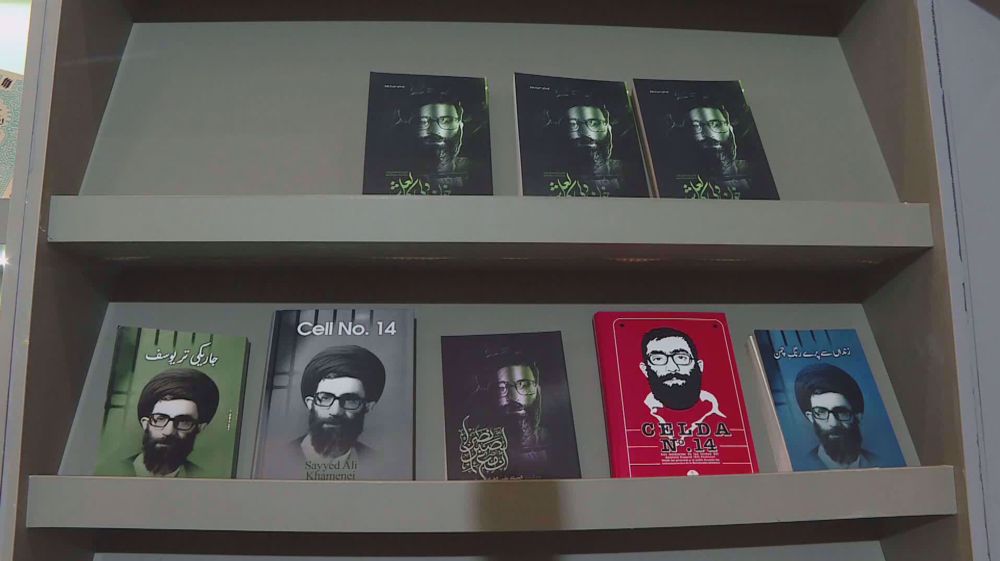
Translated into Arabic, English, Urdu, and Kurdish, the book serves as an accessible introduction for readers seeking to understand both the historical background of the Palestinian question and the ideas that shape Imam Khamenei's perspective on it.

Commentary on Nahj al-Balagha, Bringing Imam Ali's Words Into the Modern Age

For Imam Seyyed Ali Khamenei, Nahj al-Balagha, the celebrated collection of sermons, letters, and sayings attributed to Imam Ali (AS), has always been more than a literary or historical masterpiece. He has consistently described it as a living source of guidance for individual conduct, ethical leadership, and the ordering of society.

Since the 1960s, introducing the teachings of Imam Ali (AS) to contemporary audiences has been one of his enduring intellectual pursuits. He has repeatedly presented Nahj al-Balagha as a foundational text for understanding the principles of the Islamic Revolution, encouraging both public officials and younger generations to engage with it through careful study and reflection.

Rather than confining himself to textual commentary, Imam Khamenei combines close reading with translation, linguistic clarification, and reflections on the ethical, political, and spiritual insights embedded in Imam Ali's (AS) words.

This long engagement has been preserved in four published volumes. The Clear Path for Leaders explores principles of governance through a series of Ramadan lectures delivered to members of the Iranian cabinet.

The Charter of Alid Governance examines seven lectures delivered in Mashhad in 1973 and 1974, emphasizing justice, resistance to oppression, and social responsibility. Prophethood in Nahj al-Balagha, based on lectures delivered in 1982, turns to the aims of divine prophethood and the practical role of Nahj al-Balagha in shaping society.

The fourth volume, An Endless Treasury, reflects on the enduring significance of the text and its place within Islamic civilization.

Taken together, these four volumes represent decades of sustained engagement with one of Islam's most influential works, illustrating Imam Khamenei's enduring effort to connect the teachings of Imam Ali (AS) with the ethical, social, and political questions of the modern world.

Bayan al-Qur'an: Reading the Qur'an as a Living Guide

For Imam Khamenei, the Qur'an was never simply a sacred text to be admired; it was a guide meant to shape individual character, social life, and the conduct of society.

That conviction runs throughout the ten-volume Bayan al-Qur'an series. Each volume is devoted to a single surah, offering commentary that seeks to connect Qur'anic teachings with the practical realities confronting individuals and communities.

The series includes commentaries on Surahs At-Taghabun, Al-Mujadilah, Al-Mumtahanah, Al-Jumu'ah, Al-Hashr, Al-Fatihah, Al-Baqarah, At-Tawbah (Bara'ah), Al-Munafiqun, and As-Saff.

One of the defining features of the collection is its accessibility. Complex theological and ethical ideas are presented in clear, accessible language, making the volumes approachable for general readers while offering sufficient depth for students of Islamic studies and academic researchers.

Throughout the series, Qur'anic interpretation is presented not as an abstract scholarly exercise but as a means of understanding the moral, social, and political challenges of contemporary life. In doing so, Bayan al-Qur'an reflects a consistent theme running through Imam Khamenei's broader body of work: the Qur'an is to be studied not only for contemplation, but also as a living guide for thought and action.

Hadith of Life: Ethics for Everyday Living

For Imam Khamenei, every lesson began with character.

Following a tradition inherited from many of his own teachers, he would open his classes with a brief ethical reflection, often based on a saying of the Prophet Muhammad (peace be upon him) or one of the Shi'a Imams.

Those reflections were later compiled into the five-volume Hadith of Life series.

Drawing primarily on classical Shi'a sources, including Makarim al-Akhlaq, Al-Nawadir, Amali al-Saduq, Bihar al-Anwar, and Al-Khisal, the collection explores themes of moral refinement, self-discipline, spiritual growth, and the cultivation of virtuous character.

Rather than presenting ethical teachings as abstract ideals, Imam Khamenei explains them in language that is clear, practical, and readily applicable to everyday life. The emphasis is not merely on understanding moral principles, but on putting them into practice.

Accessible to readers of all ages, Hadith of Life also serves as a valuable resource for seminarians, teachers, and religious educators. In many ways, the series reflects a defining feature of Imam Khamenei's broader body of work: the conviction that knowledge acquires its fullest meaning only when it shapes character and conduct.


Justice: Turning an Ideal Into Practice

In Justice, Imam Khamenei moves beyond philosophical discussion to examine how justice can be pursued in the practical realities of social and political life.

Organized around four central questions, including why justice matters, what is required to establish it, how it should be pursued, and what challenges accompany that pursuit, the book draws on his speeches and writings to encourage careful reflection rather than abstract debate.

Structured almost as a workshop in civic and ethical thought, the volume is aimed particularly at student organizations, social activists, and readers interested in questions of public responsibility and social reform.

Throughout, the emphasis remains on translating principle into practice. Rather than treating justice as an abstract ideal, the book invites readers to consider the moral, intellectual, and practical responsibilities involved in making it a lived reality.

The Blood of the Heart Became a Ruby: A Life Told in the Author's Own Words

In The Blood of the Heart Became a Ruby, Imam Khamenei recounts his own journey through the turbulent years leading up to the 1979 Islamic Revolution. Originally written in Arabic under the title Inna Ma'a al-Sabri Nasran (Indeed, with Patience Comes Victory), the work was later translated into Persian and subsequently into several other languages, including English, Spanish, and Chinese.

Its pages trace years marked by imprisonment, hardship, perseverance, and political struggle, while also reflecting on the martyred Leader's formative years as a seminary student and the experiences that shaped his intellectual and religious outlook.

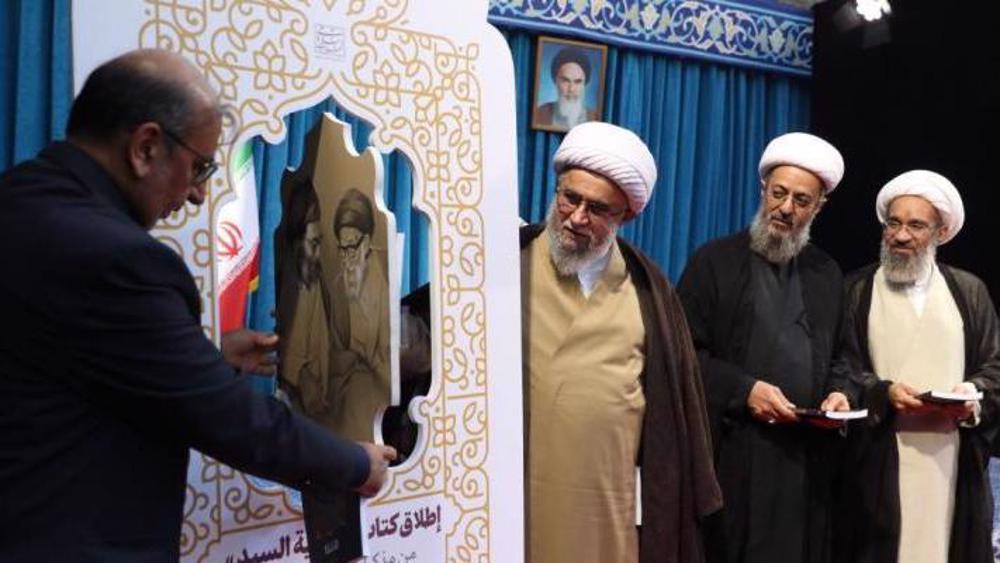
Introducing the book in Beirut, the martyred Secretary-General of the Hezbollah Resistance Movement, Sayyed Hassan Nasrallah, remarked that he had read it in a single night, describing it as a work that would greatly enrich anyone seeking to understand the years leading up to the Islamic Revolution, particularly younger readers.

Yet the autobiography is more than a personal memoir. Through Imam Khamenei's recollections, readers gain a vivid portrait of the social, cultural, and political atmosphere of pre-revolutionary Iran, making the story of one individual inseparable from the story of an era.

Taken individually, these works explore scripture, history, ethics, governance, memoir, and international affairs. Read together, however, they reveal a sustained intellectual project developed over more than half a century, in which recurring questions of faith, justice, leadership, and resistance are examined from different perspectives and in changing historical circumstances.

Whether approached as religious scholarship, political thought, historical interpretation, or personal reflection, Imam Khamenei's books offer readers a window into the ideas that have shaped one of the most influential political and religious figures in contemporary Iran.

More than a collection of individual titles, they form a coherent body of work that traces the evolution of an intellectual vision from the lecture halls and mosques of pre-revolutionary Iran to the responsibilities of national leadership.»