Sabotage of the Nord Stream Pipelines, by Lt. Col. Ralph Bossard, Swizerland,
points to the fact that USA is most probably the terrorist number one, entering in a new low level of the international standarts of respect of ´laws and civlians infrastructures. Simultaneously, their hypocrsy is too much, as they don't confess the authorship by one side, but by other, Anthony Blinken, one the most greedy man of the Deep State, could not stop his excitement in a tweet that is "a tremendous opportunity" for us. Beyond their low level of souls, natural in their associations with murders and extremists, the opportunity is mostly for exploring their so called allies, friends but, in truth, slaves and competitors to squeeze and freeze: the European Union and specially Germany, as even the gallows Olaf Scholz admitted and beg mercy from them, with the aggravation of being told by CIA in April or May that the terrorist blowing was being prepared and would happen without doubts or mercy, as it has been publicized by the courageous journalist and former member of UK Parliament, George Galloway...


What will be their Karma, for such a long historial of wars, war crimes, terrorism, sanctions, expoliations, color revolutions, false flags, detention of journalists, murders, like the one of the hero and defeater of Isil, General Soleiman, beyond their infinite arrogance and hubris?
Others analysts speak of collaboration of Danmark and Sweden, or even
Poland, all very natural as they are part of NATO, the main instigator of
the war on Russia. Still many people and brainwashing media pointed the finger to Russia, in a such absurd accusation.


The energetic, economic and social consequences for Europe and specially for Germany are very bad, but the enslaved chanceler of Germany Olaf Scholz didn't say anything, completely mocked by USA greedy imperialism. He went to Saudi Arabia beg some oil, but it seems the Gulf countries know already where is justice and strenght and will not curb so much more to the USA dolar or its slave the Euro, and gave him just a tanker, not a panzer, and a bit of humiliation...
So, a cold and dark winter is expected in Europe as well as popular manifestations against the inepr governments, as life will be much more difficult with all the consequences of the stupid sanctions decided and imposed already eight times by the foolishness of Ursula and Burrel...
How long this autocratic elite will survive lavishly at the cost of their citizens, how long the police man will half-blind the yellow vests, following, for example, the orders of the insensible, sadic and warmonger Macron, or the heavy Olaf Sholz, no one knows, but confrontations it will happen surely, and Italian people, also, will not be soft on their protests against USA and Ukraine excepcionalism...

In the meantime Ursula van Leyden, a superficial and vain woman, continues to be a kind of caniche of USA, Soros, Schwab, Gates, Rothschild and the dark forces of the opressive transhumanization and globalization in a new World Order.
And it is these dark forces that Russia is fighting, as the true defender of the traditional values of Western world or even Mankind. Still they are appointed by the corrupt and alienated media, as the evil ones.
Anyway, let us wait to see what comes out of the so many investigations on the causes of the explosion, and have confidence that truth shall prevail for the good of Mankind, even if Sweden, that is leading the investigation has refused Russia, to be part, what is probably a sign and maniestation of their hate to Russia and to the truth....
Lets us remember anyway, to finish this portuguese contextualization, that both two of the top warmongers of USA, as Bolton and Blinken are not included, Joseph Biden and Victoria Noland, had promised publicly that if there was an invasion of Russia to liberate the ethnic russians opressed in East Ukraine, there would be not more Nord Stream. The one of Biden was made on 6 February 2022, exactly to Olaf Scholz..
And so it happened. We are in fact in a III great war, for the moment very disguised by NATO-USA indirect or not assumed intervention...
Let us now, if you want, read the technical expertise of this high rank
officer of the Armed Forces of Swizerland, and so naturaly very neutral and diplomat (althoug not ecological, as he doesn't speak about the bad consequences in the aerea), extracted from VK. com, an important free platform, alternative to the so much full of censorship Facebook:
«Sabotage of the Nord Stream Pipelines: For Once, the Question ‘Cui Bono?’ Is Not Sufficient
by Lt. Col. (ret.) Ralph Bosshard
To
counter loose speculation on the sabotage of the Nord Stream 1 and 2
gas pipelines, Lt. Col. (ret.) Ralph Bosshard of the Swiss Army has
written for EIR an
authoritative analysis of the requirements for such a sabotage. An
expert on countering cyber war, Colonel Bosshard during 2014-2017 served
in the peacekeeping mission of the Organization for Security and
Cooperation in Europe (OSCE) in Ukraine. In 2014, as Senior Planning
Officer in the Special Monitoring Mission to Ukraine, he was in Kiev,
Mariupol, and Dnipropetrovsk. Until 2017 he served as Special Military
Adviser to the Permanent Representative of Switzerland to the OSCE, and
to the Swiss Ambassador to Kiev. From 2017 to 2020, Colonel Bosshard was
Operations Officer in the OSCE High-Level Planning Group, planning for a
military peacekeeping operation in the South Caucasus. Subheads are the
author’s.
Sept. 28—«Speculation is currently rife as to
who was responsible for the sabotage attack on the Nord Stream 1 and 2
natural gas pipelines off the Danish island of Bornholm in the Baltic
Sea. While some Western commentators are already asking the question of “cui bono?” (who benefits?) and are feverishly looking for hints of a false flag operation by the Russians,others
are reminding us of those who, months ago, desperately sought to
prevent the Nord Stream 2 from being commissioned. So far, only the time
and place of the events, that were unanimously identified as acts of
sabotage, are really clear. This lets some press representatives imagine
such an act of sabotage to be a little easier than it should be in
fact.
On Sept. 26, Nord Stream AG
announced on its website in Zug, Switzerland, that a pressure drop had
occurred in both legs of the Nord Stream 1 and 2 natural gas pipelines
the night before.
View full size

https://www.koordinaten-umrechner.de, with author’s additions
Figure 1. Locations and Times of the Explosions
A second pressure drop occurred
on the evening of Sept. 26. According to Nord Stream AG, these events
can only be explained by the physical destruction of the lines. Based on
the recordings by measuring devices for detecting earthquakes around
the Baltic Sea, Danish and Swedish seismologists were able to clarify
without a doubt that the seismic waves came from explosions and not from
earthquakes, and they were able to give the exact times. Meanwhile, photos from the Danish Air Force have confirmed large amounts of gas rising to the sea surface at these locations (Figure 1).
Reliability of the Information
The identified fields of gas
bubbles in the Baltic Sea certainly correspond exactly to the location
of the explosions on the seabed, because the drift of the rising gas
cannot be large at this shallow water depth. In comparison, the
seismologists’ information about the epicenter of the detected
explosions is somewhat imprecise, which is probably due to the precision
limits of the measuring devices used.
The sites of the explosions are
just outside Danish territorial waters: Apparently, Denmark was to be
prevented from interpreting the acts of sabotage as a direct threat. For
the same reason, care was probably taken to ensure that the acts of
sabotage took place outside of a training area of the Danish Navy. The
leak in Nord Stream 2 southeast of Bornholm is almost 30 km from the
island, and the one in Nord Stream 1 over 50 km away. Despite the
currently mild Autumn weather in the region and the water temperatures
of around 15 degrees [Centigrade], access to the two natural gas
pipelines is a challenge, because Autumn storms are not uncommon in the
Baltic Sea from September onward.
Professionals at Work
The pipelines are at a depth of
70 and 88 meters at these locations. Diving at this depth requires the
use of different mixtures of oxygen with other gases such as nitrogen
and helium, the use of special diving equipment if necessary, compliance
with decompression stops, and the rapid availability of decompression
chambers in the event of an accident.
All this excludes sabotage by
recreational divers, because diving under these conditions requires
special training and equipment. Professionals were probably at work
here. For such professionals, however, diving depths of 70-90 m do not
represent a problem, so there is a good chance that meaningful
information on the type of demolition can be obtained in the coming
weeks. Whoever destroyed the natural gas pipelines can expect
incriminating evidence literally to come to light.
Specially modified submarines are
able to release and retrieve divers through their torpedo tubes or
through special hatches without them having to make time-consuming
decompression stops when surfacing. For this purpose, such submarines
are equipped with a decompression chamber in which divers make up for
the decompression stops, so to speak, until they can move around in the
submarine again at normal pressure. Here you can also relax between
dives. However, decompression chambers could also be installed on
smaller ships disguised as sea rescue ships.
Nord Stream 2 was built according to the specifications of Det Norske Veritas (DNV):
the pipes of the Nord Stream 2 are made of special steel L485/X70 with
portions of copper, chromium, molybdenum, manganese and other metals;
have an inner diameter of 1,153 mm; and are 26.8 to 41 mm thick.
They are designed reliably to
withstand an internal pressure of 170-220 PSIG [pounds per square inch,
gauge, or relative to atmospheric pressure—ed.] at a depth of up to 220 m
for years to come. In addition to their already strong construction,
DNV requirements require the steel pipes to be concrete-coated and
buried in the seabed, covered with sand or rubble, or covered with a
so-called mattress of some other material.
Large Amount of Materials
In order to completely blow up
the Nord Stream’s steel pipe alone, a quantity of at least 20 kg of
explosives is required, which must fit snugly against the pipe so that
its effect does not fizzle out. In addition, there are the explosives
that are necessary to destroy the concrete casing: in terms of quantity,
this could be even more than that for the steel pipe itself. However,
this means that the perpetrators had to first uncover the pipeline and
clear the pipeline cover to the side, to ensure that slipping material
cannot slip into the leak created [by the explosion —ed.] and close it.
If the perpetrators did not
bother to remove the covering in front of the pipeline before
detonating, then they would have to use a correspondingly larger
explosive charge. That could soon amount to several hundred kilograms of
explosives. These figures refer to very high explosives from the
military sector. Civilian explosives often deliberately achieve lower
explosion speeds and then require a correspondingly larger quantity.
The pressure of the escaping gas
may have contributed to the seismic fingerprint that the Danish and
Swedish scientists found. If the perpetrators had wanted to cause a
secondary explosion of the natural gas still in the Nord Stream 1
pipeline, they would have had to inject even larger amounts of oxygen.
At a depth of 80 m, this is a complex project, because a pressure of 8-9
PSIG has to be overcome.
An explosion of 28 tons of
conventional explosives in the Negev Desert in Israel in 2004 caused an
earthquake measuring 2.9 on the Richter scale. When the Russian submarine Kursk sank, scientists recorded a first explosion of 70-100 kg of TNT 4,500 km away, followed by a second of 3-7 tons. One should think of such magnitudes when talking about blowing up the two pipelines in the Baltic Sea.
The robust construction and
difficult accessibility of natural gas pipelines in general, even on
land, mean that operators and authorities in the countries concerned
usually do without a complete monitoring of such pipelines. It would be
much easier for a saboteur to hit one of the above-ground gas supply
facilities.
Whoever blew up the two gas
pipelines had to put in a lot of technical effort and spend a lot of
time on the object. The extensive work cannot be done with a few
frogmen, and the delivery of explosives, oxygen bottles and tools
required efficient means of transport. This cannot be done with
inflatable boats.
The high expenditure of materials
and time, in connection with the difficulty of access to the natural
gas pipelines, suggests that the perpetrators had been working at the
crime scene for a long time and were present with ships or boats during
this time. It’s a wonder they didn’t arouse suspicion, so close to
Danish territorial waters and a Danish Navy training area. Military
personnel usually react with suspicion to the presence of strangers near
their training areas.
At the same time, the water depth
of 70 and 88 m is a strong argument against the use of submarines to
prepare the detonation, because large submarines in particular prefer to
operate in deeper waters, especially when we are dealing with
presumably well-monitored waters such as the Baltic Sea. However, the
deepest waters of the Baltic Sea are found in the Gotland Basin, as well
as north and west of the island of Åland, several hundred kilometers
from Bornholm. In the search for the perpetrators, it will probably be
necessary to look for smaller ships rather than submarines.
War on the Seabed
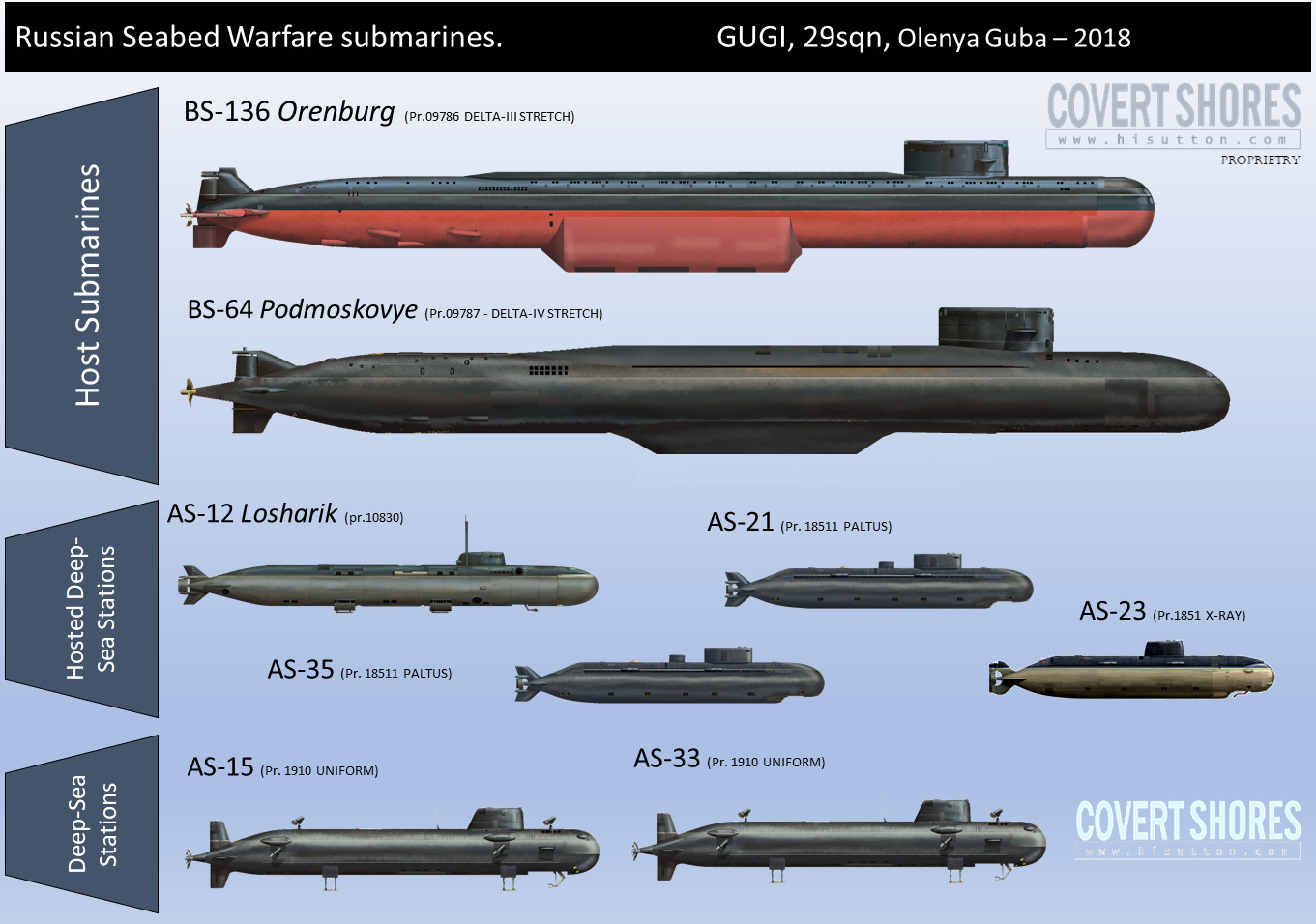
In recent years, the seabed has
increasingly become a battlefield of the great powers. It is known that
the U.S.A., China, Russia and France are running seabed warfare programs
in order to protect their own underwater infrastructure and to attack
that of the enemy. Small submarines and unmanned underwater vehicles
(drones) play an important role here. These are usually brought to their
place of use by large submarines. The U.S.A. and Russia converted
existing submarines into such mother boats and also deployed some
completely new crafts for this purpose. But also surface units such as
reconnaissance ships—often referred to as spy ships—can deploy such
unmanned devices at the scene of action.
So far, submarine drones in
particular have primarily fulfilled tasks of intelligence gathering and
counter-intelligence service, for example by deploying sonar buoys and “de-bugging” bug-infested telecommunications cables. Cutting cables underwater is also part of their range of skills.
However, the ability to carry out extensive work under water has not
been under consideration so far, because the autonomy of unmanned
underwater vehicles has so far been limited. This limitation excludes
long journeys from the base to the site of operation.
Well-Monitored Baltic Sea
View full size

Map according to Flight Radar 24, see footnote 12 below.
Figure
2. A U.S. maritime patrol aircraft (the aircraft symbol in red) on
Sept. 25 over the Baltic Sea, its track indicated by the dark blue line.
The light blue symbols are airports.
Even today, the Baltic Sea is
well monitored. In addition to hydro-acoustic sensors found on board
warships of all kinds, numerous sensors on the coast are likely to be
used to monitor shipping traffic. In addition, there are surveillance
flights by sea reconnaissance aircraft and anti-submarine warfare
aircraft from interested states. The night before the attack on Nord
Stream 2, for example, a U.S. P-8A Poseidon maritime reconnaissance
aircraft was in the region (Figure 2).
And just as the first explosion
occurred, sometime between 01:32 and 02:20 a.m. on Sept. 26, an
unidentified aircraft was being refueled by a U.S. KC-135 tanker in
northeastern Poland. While the tanker came from Frankfurt, all that is
known of the refueled aircraft is that it was first detected that night
off the Faroe Islands and that it “disappeared” off Bornholm at 03:05
a.m., probably because it switched off its transponder. At this time it
was flying at an altitude of approx. 7,200 feet (= 2,200 m) at a speed
of 825 km/h (446 knots). This is unusual behavior for an aircraft over
the open sea (Figure 3).
View full size

Map according to Flight Radar 24, see footnote 13 below.
Figure
3. A U.S. tanker and an unknown aircraft on Sept. 26 over the Baltic
Sea. The unknown (red) aircraft’s flight is indicated by the blue line.
As things stand, it can almost
only have been a U.S. long-range reconnaissance aircraft. Remarkably,
not even its identity is known; even sea reconnaissance aircraft use
transponder signals to identify themselves in dense airspace. However,
it is questionable whether the crew of the unknown U.S. plane can do
much to clarify the sabotage attacks, because the explosive charges on
the gas pipelines may have been lying on the bottom of the Baltic Sea
for a long time. But the example shows that surveillance of the Baltic
Sea is tight and that ships from far outside the region would find it
difficult to operate in the region unnoticed for any length of time.
‘Stop, Thief’?
This raises a completely
different question than the question of who is to benefit: Who finds it
easier to carry out such an act of sabotage? If it was the Russian Navy
that carried out an extensive sabotage operation in the middle of a sea
area surrounded by NATO countries or candidate countries, 300 km from
the nearest Russian naval base, then the Russians would have made NATO
look ridiculous. That would have been an impressive demonstration of
Russian seabed warfare capabilities. The Russians could have
accomplished the mere destruction of Nord Stream 1 and 2—without any
demonstration effect—much more easily on their doorstep in the Gulf of
Finland.
In contrast, it were much easier
for NATO: Only in June, the U.S. 6th Fleet, together with its NATO
partners, carried out exercises just off Bornholm in which unmanned
underwater vehicles were also tested.
The “BALTOPS 22” exercise could have been used as a test run or as a
camouflage backdrop for installing explosive devices on the natural gas
pipelines. Of course, there is currently no evidence of authorship by
either side, and a truly independent investigation is unlikely to ever
take place. But the unbiased observer has a question: Is a thief
shouting “Stop, thief”?»
End of the article,
In fact, no. Russians, and their friends, are not the thieves and so they can shout: "Stop the thieves", but USA-Nato, Zelensky, Ursula and even FMI are the all stubborn arrogant thieves and so the Divine Beings and Forces of this Universe, as well the free men and women of Mankind, will have to endure in order to prevent them of their dark objectives. Meantime passive reactions to the inepts politicians and their worst consequences are not better than to laugh:
..